
STEM Toys Wholesale for School Suppliers: Matching Age Bands, Group Sizes and Reset Time
Plan STEM toys wholesale orders with a 24-student station-rotation model, CPSC age-band rules, replacement-part counts and carton math for school suppliers.
A school-supply buyer finalizing a fall STEM order faces three numbers before any price sheet: the age band printed on the box, the number of students who share one kit, and the minutes left after cleanup. Get those wrong and a U.S. building-sets category that reached $4.3 billion in 2025 can still deliver cartons that sit in a stockroom if a 24-student class lacks the right kit count and reset budget to rotate through 4 stations in a 40-minute block.
This guide converts classroom logistics into purchase-order fields. It starts with the CPSC age-grading line that separates an under-3 SKU from a 3–5 SKU, then runs a worked station-rotation model, then specifies replacement parts per carton, and finally shows how bulk fidget toys, bulk sensory toys, and squishy toys wholesale fit reward stations without inflating the order. Every quantity below is either a cited regulatory threshold or an explicitly labeled planning example.
Age grading first: the CPSC lines that decide which carton you can buy
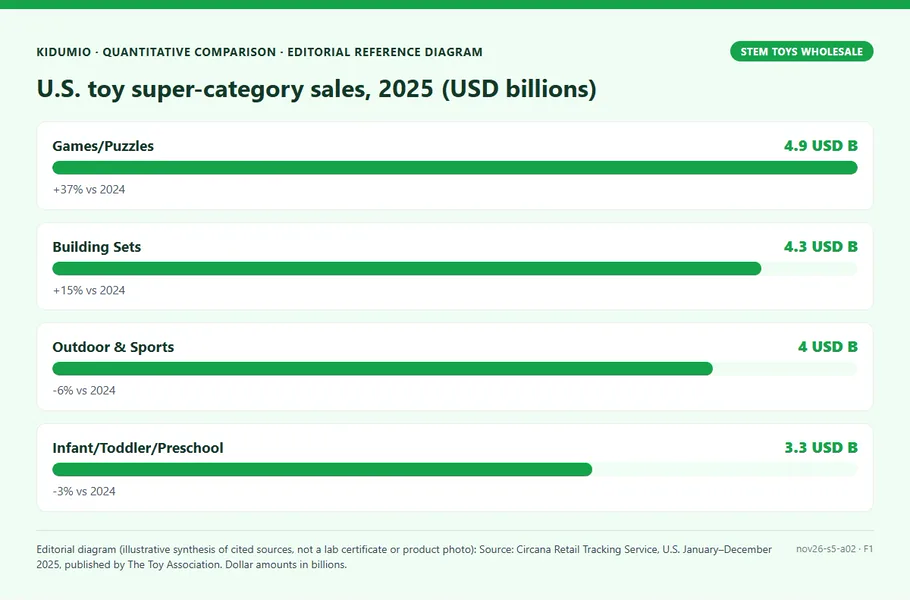
The U.S. market moved $30.3 billion in toy retail sales in 2025, up 6% versus 2024, and Games/Puzzles alone reached $4.9 billion, up 37%; the same Circana dataset shows total dollar value roughly flat versus 2021 at 0% change, so the 2025 gain is a recovery, not a new plateau. That demand pulls school suppliers toward construction and puzzle kits, but the age band on the box is a legal boundary, not a merchandising suggestion. Under 16 C.F.R. part 1501, a children's product intended for use by children under 3 that presents a choking, aspiration, or ingestion hazard because of small parts is a banned hazardous substance. A small part is any object that fits, without compressing and in any orientation, entirely into the small parts cylinder at 16 C.F.R. § 1501.4.
That rule produces a hard carton-level exclusion: a kit with loose gears, connectors, or tiles that fit the small parts cylinder cannot be placed in an under-3 assortment, even if the sample feels sturdy. The practical field on the purchase order is the intended age band plus the small-parts test result. For a 3–5 SKU, the same kit moves into a band where small parts are permitted, but the choking hazard warning labeling rules at 16 C.F.R. § 1500.19 apply to products that are or contain small parts, balloons, small balls, or marbles, and advertising for those toys must carry the same warning per 16 C.F.R. § 1500.20.
The certificate field is equally specific. Section 2 of the Children's Product Certificate should cite '16 CFR part 1501 – Small parts' for the small parts ban, and the choking hazard warning label requirement does not need to be included in a CPC. A CPC that omits the warning-label citation is not defective on that point. The ≤12 and <14 bands are merchandising age-grading designations, not CPSC rule text: the supplied CPSC small-parts guidance addresses only the under-3 ban and the choking-hazard labeling rules, so a 12-year-old or a 13-year-old can use a kit with small parts, and that fact changes nothing about the under-3 exclusion.
The station-rotation model: 24 students, 4 stations, 40 minutes
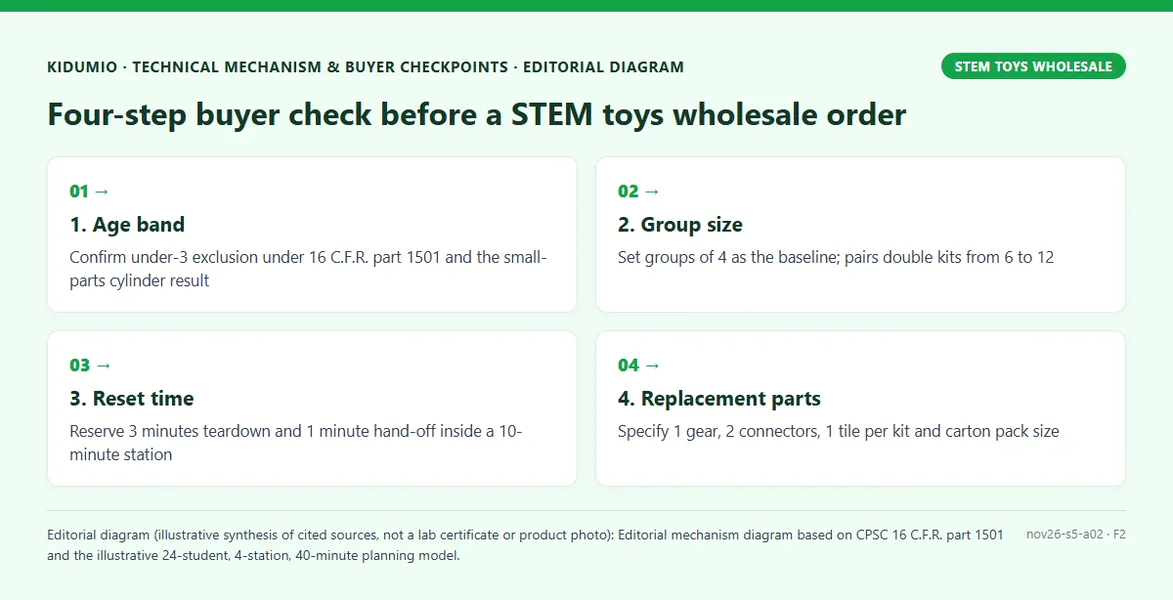
Here is an illustrative planning example, not a lab test or a price quote. A school supplier plans a 24-student classroom with 4 station rotations in a 40-minute block and uses groups of 4 as the activity baseline, matching the group size specified in Teach Engineering's grades 6–8 'Get in Gear' activity. The arithmetic is: groups = 24 ÷ 4 = 6 groups; sets needed = 6 kits; minutes per station = 40 ÷ 4 = 10 minutes; students per station = 24 ÷ 4 = 6 students. The kit count equals the group count, not the student count, so a 24-student class needs 6 kits rather than 24.
Group size is the lever that moves the order. Switching the same class from groups of 4 to pairs doubles the kit count from 6 to 12 sets, while groups of 6 reduce it to 4 sets. A supplier quoting a single 'classroom set' without stating the group-size assumption leaves the buyer unable to compare cartons. Write the assumption into the quote request: 24 students, groups of 4, 4 stations, 40 minutes.
Reset time is the constraint that breaks the model. A 10-minute station window leaves 6 minutes of hands-on building time if 3 minutes are reserved for teardown and 1 minute for hand-off. Teach Engineering's activity lists a 50-minute time requirement, which fits 4 stations at 12.5 minutes each; a 40-minute block with 4 stations fits only 10 minutes each. When the kit's teardown exceeds 3 minutes, the defensible move is to cut to 3 stations at 13.3 minutes each rather than compress building time. block-play guidance makes the same point in classroom terms: a full set of unit blocks, open storage shelves, and plenty of space and time to build and rebuild.
Age band, CPSC rule, group size and carton planning by STEM kit type
The table below converts the age bands into carton-planning fields for a 24-student class using groups of 4 and a 40-minute block. Replacement-part counts are illustrative planning quantities per kit, not Kidumio-stated pack data.
| Age band | CPSC rule | Group size | Reset minutes | Replacement parts per kit | Sets per 24-student class |
|---|---|---|---|---|---|
| Under 3 | 16 C.F.R. part 1501 small parts ban; no loose small parts permitted | 1–2 with adult | 3–5 | 0 loose small parts; 1 spare large block | Not permitted for loose-part kits |
| 3–5 | Small parts permitted; 16 C.F.R. § 1500.19 choking hazard label | 2–4 | 4–6 | 2 large connectors, 1 spare tile | 6 kits at groups of 4 |
| 6–8 | Small parts permitted; CPC cites 16 CFR part 1501 – Small parts | 4 | 3–5 | 2 gears, 2 connectors, 1 tile | 6 kits at groups of 4 |
| 9–12 | Small parts permitted; CPC citation unchanged | 4 | 3–4 | 1 gear, 2 connectors, 1 axle | 6 kits at groups of 4 |
| 13+ | General-use product; CPC not required for the small parts ban | 4 | 2–3 | 1 gear, 1 connector, 1 motor clip | 6 kits at groups of 4 |
Replacement parts per carton: the field that keeps rotations from stalling
A missing 8 mm connector stops a station as effectively as a missing kit. The purchase order needs a replacement-part line separate from the total piece count, because a 320-piece kit with 1 spare gear still stalls when two gears crack in the first month. In the illustrative 6-kit classroom order, 1 spare gear, 2 spare connectors, and 1 spare tile per kit yields 6 spare gears, 12 spare connectors, and 6 spare tiles, for 24 spare pieces total; combined with the 6 kits the order remains well below the Kidumio minimum order of 300 units, so the buyer must scale to multiple classrooms or mix SKUs to reach 300.
Tie the spare count to reset time. A station with a 3-minute teardown budget cannot absorb a 2-minute search for a dropped connector, so the spare bin belongs at the station, not in the stockroom. on open storage shelves supports that layout: parts stay visible and reachable, and the reset window stays inside the block. For a 24-classroom rollout, 24 classrooms × 6 kits = 144 kits; at 6 kits per carton that is 24 cartons, and at 12 kits per carton that is 12 cartons. Carton pack size is the variable that changes freight and receiving labor, so it belongs in the quote request next to the kit count.
Bulk fidget, sensory and squishy add-ons at reward and reset stations
Reward and reset stations need different math from construction kits. A 24-student class using 1 bulk fidget toy per student needs 24 fidget units, and 10 classrooms need 240 units, which sits below the Kidumio minimum order of 300 units. That gap is a planning signal: combine fidget, sensory, and squishy SKUs into one mixed carton so the order clears the 300-unit line without overstocking a single item.
The demand context supports the add-on. The Toy Association's 2026 trend briefing describes a Cozy Culture shift toward low-tech and no-tech toys that engage the senses through tactile materials and gentle interactivity, and it reports that 81% of parents in 2025 were likely to add a toy or game for themselves to their holiday shopping list, up from 72% the year prior, with kidults accounting for roughly one-quarter of U.S. toy sales. For a school supplier, that means a carton mix of 1 STEM construction kit plus 2 fidget or sensory units per student group covers both the building station and the reset station.
Age-band the add-ons with the same discipline as the kits. A squishy toy with a small detachable part falls under the under-3 ban at 16 C.F.R. part 1501, so the squishy toys wholesale line for a preschool assortment must be molded as one piece. A fidget toy for a 9–12 band can carry small moving parts, and its packaging carries the 16 C.F.R. § 1500.19 warning. note that a child's brain develops more in the first three years than at any other time is the reason preschool buyers should not accept a '3+' label on a product with loose pieces.
Supplier brief fields to send with every STEM toys wholesale RFQ
Kidumio's supplier-stated profile lists a minimum order quantity of 300, a lead time of 25–35 days, 8,000 pcs monthly capacity, 15 production lines, 200+ staff, 30+ export countries, and EN71 certification; treat those figures as supplier-stated and confirm them on the quotation. The RFQ should carry 8 fields: intended age band, small-parts test result, group size assumption, kits per classroom, replacement parts per kit, carton pack size, CPC citation, and destination-market certificate. For a U.S. order, the CPC citation field reads '16 CFR part 1501 – Small parts' when the small parts ban applies, and the EN71 certificate covers the EU destination separately.
How many STEM toy kits do I need for a class of 24?
Six kits cover a class of 24 when students work in groups of 4 across 4 stations. Each station then serves 6 students for 10 minutes in a 40-minute block, and pairs double the requirement to 12 kits.
Can a STEM kit with small parts be sold for children under 3?
No. Under 16 C.F.R. part 1501, a children's product intended for use by children under 3 that presents a choking, aspiration, or ingestion hazard because of small parts is a banned hazardous substance. The small parts cylinder at 16 C.F.R. § 1501.4 defines the test, and a loose gear or connector that fits entirely into the cylinder excludes the kit from the under-3 band.
What CPC citation should the supplier use for small parts?
Section 2 of the CPC should cite '16 CFR part 1501 – Small parts'. The choking hazard warning label requirement does not need to be included in a CPC, so a certificate that omits the warning-label citation is still compliant on that point.
Build the carton around the classroom, not the pallet
Send Kidumio the 8 RFQ fields with your age band, group size, kits per classroom, and replacement-part counts, and request a mixed carton that clears the 300-unit minimum across STEM construction, fidget, and sensory SKUs. The quote returns with carton data, lead time of 25–35 days as supplier-stated, and certificate document coordination for the destination market.
Sources
www.cpsc.gov — Small Parts Ban and Choking Hazard Labeling | CPSC.gov