
Real Play Patterns to Watch at the Hong Kong Toy Fair: A 2027 Preview for Education Buyers
Compare six real toy references by play mechanism, components and size, then plan an education-focused visit to the Hong Kong Toys & Games Fair.
Which play mechanisms deserve a classroom shortlist? I would favor those that make the child’s decision visible: distinguishing an animal sound, arranging an equation, steering a ball through a maze or adjusting a shot after a miss.
The , scheduled for January 11–14, 2027, at the Hong Kong Convention and Exhibition Centre, offers a useful setting for comparing those actions across very different toys.
The six catalogue references below are pre-fair comparators, not a confirmed exhibitor or launch list, and their descriptions are not classroom trial results; they give education buyers specific mechanisms to seek in live demonstrations before discussing price.
Where should an education buyer start?
Start with Educational Toys & Games, then compare electronic prompting in AI & Smart Toys rather than treating technology as a separate measure of educational value.
Both appear in the , alongside Green Toys; the concurrent Stationery & School Supplies Fair also makes sense for buyers building broader classroom assortments.
My touring notes would record a verb and a decision, not just a category: “press the animal matching the sound” says more than “interactive,” while “arrange symbols into an equation” says more than “STEM.”
That turns the fair into a library of comparable play patterns, with the demonstration—not the adjective on the box—doing the persuasive work.
Listen and press: separate recognition from reaction
Animal Game Machine, CPS349394, lists 5 modes: animal-sound matching, color matching by sound, shape recognition, Tic-Tac-Toe and Whack-a-Mole.
Its 3 sound- or voice-led recognition modes provide a useful fair-floor contrast: identifying an animal sound is different from understanding a spoken color or shape instruction.
The Tic-Tac-Toe mode is described for 2 players, shifting the comparison toward alternating decisions, while Whack-a-Mole emphasizes responding to rhythm.
The ABS unit measures 10 × 3.1 × 8.5 cm, so I would handle the controls while listening to a complete prompt, then deliberately make an incorrect selection to hear the response.
Its retail box measures 10.5 × 3.1 × 8.7 cm; that near-body-size packaging is relevant when comparing individually boxed activities for classroom distribution.
The catalogue specifies dry-cell power without recharging, making battery access part of the hands-on demonstration, alongside prompt intelligibility and whether the response helps a learner understand the next move.
Connect and arrange: make the mathematics observable
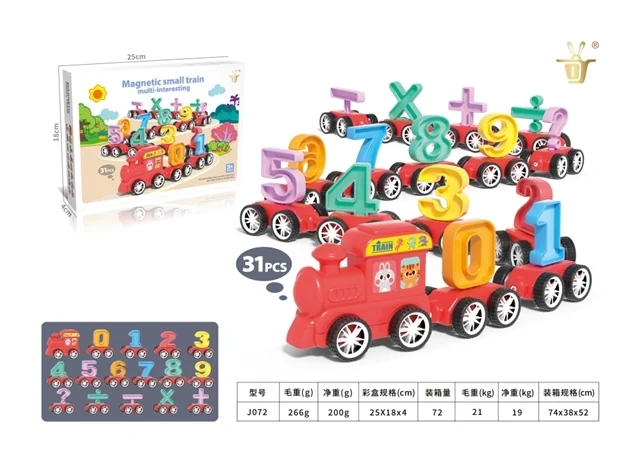
Magnetic Digital Train, CPS308814, is a 31-piece ABS set combining magnetic carriage connections, wheels and number-and-symbol blocks.
The supplier lists numerals 0–9, giving the demonstration a concrete starting point: select a number, arrange it and explain what it represents.
The 4 arithmetic operations—addition, subtraction, multiplication and division—allow a more revealing comparison than simply watching the train roll: ask the demonstrator to change an equation and explain the changed relationship.
The set requires no batteries, while its 25 × 18 × 4 cm package describes storage rather than the length of an assembled train.
For school-supplier assortment planning, the listed 72 units per carton refer to packaged sets, not the number of components children receive.
At the fair, I would shortlist this pattern for the combination of connection and representation: the magnetic assembly attracts handling, but the meaningful classroom observation is whether the learner can explain the symbol arrangement.
The 31-piece component count and 72 packaged sets per carton answer different questions: the first describes the learning kit, while the second describes school-supplier replenishment. Photograph the number-and-symbol layout separately from the outer carton label so neither quantity replaces the other in the fair notes.
Make a move: let the rule explain the magnet
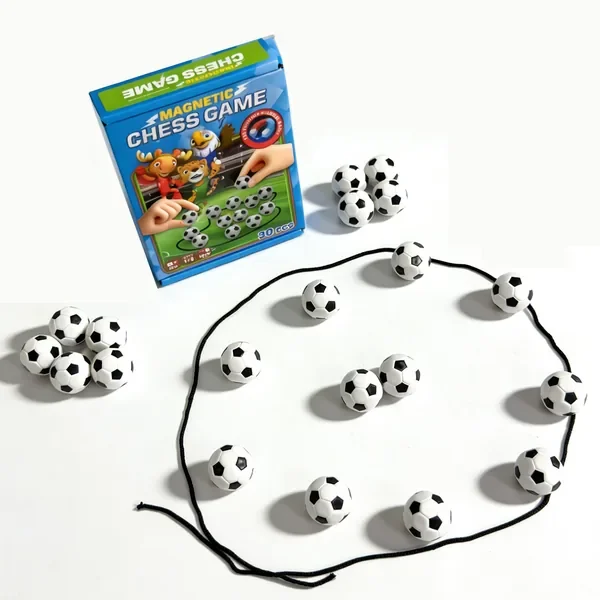
Football Chess Game Toy, CPS349241, is catalogued as ABS magnetic football-themed battle chess, in a color box measuring 13.7 × 3.8 × 17.6 cm.
Its listed 32 units per carton offer a smaller packaged-unit replenishment scale than the train, although neither carton count tells you how much tabletop space a game needs.
For this mechanism, I would ask the demonstrator to play a legal move, show the opponent’s response and explain how the round ends, then move the magnetic elements myself.
That sequence reveals whether the rule is teachable and the magnet assists handling; a football theme alone cannot show how readily the next learner understands the game.
Tilt and recover: look for a readable challenge
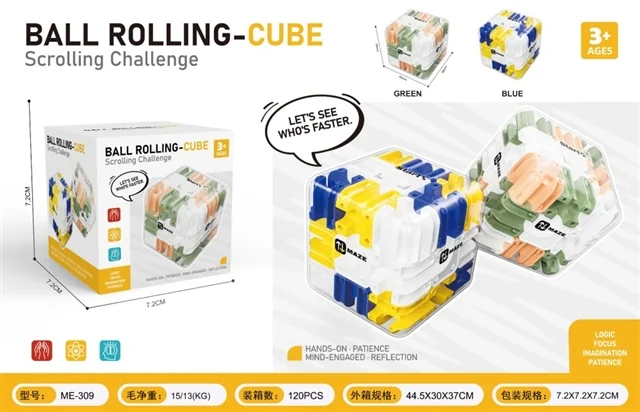
The public page for 3D Ball Cube Maze Puzzle, CPS342803, describes tilting and rotating a transparent cube to guide a steel ball through internal tracks.
The ABS product measures 6.8 × 6.8 × 6.8 cm, making hand position and visibility worth comparing with larger maze demonstrations at the fair.
Its package measures 7.2 × 7.2 × 7.2 cm, a separate storage reference rather than an additional play surface.
The listed 120 units per carton represent individually packaged puzzles, useful context for a school supplier considering a compact independent-activity range.
I would watch a recoverable mistake rather than demand a flawless run: the revealing moment is whether the player can see where the ball went and choose a different movement without an adult taking over.
Transform and identify: distinguish dexterity from literacy
The Alphabet Robots listing, CPS-125504, describes a 26-piece plastic ABC product whose figures transform into corresponding letters.
That is a different building proposition from connecting train carriages: the physical action has a recognizable symbol as its destination, so I would watch both the transformation and the learner’s identification of the result.
At comparable fair demonstrations, ask for a letter to be selected before transformation and named afterward; that separates recognizing the symbol from copying the demonstrator’s hand movements.
This is the shortlist candidate for buyers interested in construction-like handling with an alphabet task, while component organization and an understandable return-to-letter sequence belong in the demonstration.
Aim and launch: use the miss, not just the score
The Desktop Ball Hop Game, CPS341488, uses a non-electric launcher, plastic balls and scoring holes, with a rigid ABS frame.
Its listed product dimensions are 35 × 19 × 28 cm, so the fair demonstration should show the activity on a table, including where missed balls go.
The retail package measures 30 × 5 × 22 cm; buyers should keep that packed format separate from the listed product dimensions when planning classroom storage.
The catalogue lists 48 units per carton, a packaged-game quantity rather than a count of launch balls.
I would compare an initial miss with the next attempt: can the player observe the result and change the action, or is the demonstrator simply repeating shots until something scores?
For education buyers, that visible adjustment is the interesting play pattern, while ball retrieval and handover determine how comfortably it fits the intended activity area.
Turn the play-pattern shortlist into a fair visit
The official window runs December 11, 2026–February 10, 2027, providing a catalogue-research period around the physical show.
Click2Match is scheduled for January 4–21, 2027; use the matching period to frame a specific demonstration brief, such as audio recognition, equation arrangement or mechanical targeting.
directs buyers through the fair’s To Visit entry, personal or SSO information, company details and matching interests to confirmation; an upcoming fair may display an information-coming-soon message.
At the venue, connects booth or product QR codes with details, favourites, chat and meeting scheduling, so attach the observed play action to the saved product rather than relying on its name.
For arrival planning, places Exhibition Centre MTR station, Wan Chai MTR station and Wan Chai ferry pier within a 10-minute walk.
Prepare a demonstration brief
Your next action: write a short brief for fair meetings stating the intended classroom activity and asking to see the child’s decision, an incorrect attempt and the next learner’s start.
Those observations give unlike toys a common comparison language—and give the Hong Kong fair visit a sharper purpose than collecting products labeled “educational.”