Puzzle Toys Wholesale for Classrooms: What Actually Fits
How to source puzzle toys wholesale that actually fit a classroom: verify age grading, safety certs, small parts rules, durability, and supplier evidence.
A puzzle toy belongs in your classroom catalog only when it matches the age group, survives daily group use, and carries the compliance paperwork your school district or retail buyer will ask for — otherwise it is just another SKU that collects dust. Classroom fit is a verifiable match between the product’s age grade, its safety testing (ASTM F963 under CPSIA for the U.S.), its build quality, and the supplier’s ability to prove both. This article shows school suppliers, educational distributors, and institutional buyers how to evaluate puzzle and logic toys against those four checks — and what to ask the factory before you commit to a wholesale order.
If you are sourcing for a learning retailer or a school supply catalog, your decision should rest on comparable product and supplier evidence: the same way you would compare two vendors on price, compare them on age grading, small-parts risk, material durability, and compliance documentation.
What does 'classroom fit' mean for puzzle toys?
Classroom fit means the puzzle can be used safely and effectively by the intended age group in a shared, supervised setting — and that the product’s design, packaging, and documentation line up with how schools and districts actually buy. For a 5-year-old classroom, a 100-piece puzzle is a frustration, not a learning tool; for a 10-year-old, a 12-piece puzzle is busywork. So the first question is not 'is this puzzle educational?' but 'which age is this puzzle designed for, and does that match my classroom?'
The U.S. Consumer Product Safety Commission (CPSC) defines a toy as any object designed, manufactured, or marketed as a plaything for children under 14, and its testing and certification requirements apply to products intended primarily for children 12 and under. That means your age grade is not a marketing choice — it determines which parts of ASTM F963 (codified at 16 C.F.R. part 1250) apply, and whether you need third-party testing and a Children’s Product Certificate (CPC). For a classroom supplier, that translates into a simple rule: know the age range on the box, and make sure the factory can produce the certificate that matches it.
Key Takeaways for Sourcing Puzzle Toys for Classrooms
- Age grade drives compliance, not just marketing: Under CPSC rules, toys intended primarily for children 12 and under need third-party testing and a CPC. For younger groups (under 8), small parts, sharp edges, and cord rules are stricter. Always confirm the age grade with the factory before you spec the product.
- Small parts are the #1 classroom risk: ASTM F963 bans small parts in toys for children under 3, and use-and-abuse testing applies to younger age groups. For a classroom with mixed ages, choose puzzles with larger pieces or a stated age grade of 3+ to avoid choke hazards.
- Durability is a classroom spec, not a nice-to-have: A puzzle that survives one child at home may not survive 20 children in a center. Ask for material type (wood, ABS, plastic), edge finish, and any drop or impact test data the factory can share. HDPE is stiffer than LDPE and suits rigid molded parts; ABS is common for durable puzzle frames.
- MOQ and OEM depend on the product, not the category: In Chenghai/Shantou, MOQs for puzzle toys vary by spec — a simple plastic puzzle may start around 24–72 units, while a 3D maze puzzle might require 600. Custom packaging and branding (OEM) usually require a higher MOQ and a design file in AI or PDF with bleed and safe margins.
- Verify the supplier, not the catalog page: Supplier qualification should evaluate capability, material control, quality records, compliance evidence, and capacity claims — not just a pretty product page. Ask for a CPC, test reports, and a factory audit or video walkthrough before you place a large order.
Where do classroom puzzle toys come from? A look at Chenghai, Shantou, and Yiwu
Most puzzle toys sold in North American classrooms are manufactured in China’s Guangdong province, particularly in Chenghai and Shantou, which are known as the toy capital of China. Chenghai alone hosts thousands of toy factories and supporting mold shops, so you can source a plastic puzzle, a wooden spelling game, and a fidget push-pop from different suppliers within a short drive. The cluster’s advantage is speed: molds are made locally, components are available nearby, and you can combine multiple SKUs into one container to lower per-unit logistics cost.
Yiwu, in Zhejiang province, is the hub for small consumer goods and is better known for low-cost, high-volume novelty items rather than for complex educational toys. If you need a basic puzzle for a promotional give-away, Yiwu can work; if you need a classroom-grade puzzle with safety testing and OEM packaging, Guangdong is the more reliable base. The supply-chain advantage of Chenghai/Shantou is not just price — it is the density of mold makers, test labs, and export agents who understand U.S. compliance requirements.
For a school supplier, this means you can source a whole classroom toy category — puzzles, logic games, fidgets — from one region, which simplifies QC and shipping. But it also means you must do your own due diligence: not every factory in the cluster is equal.
How to compare puzzle toy suppliers for classroom orders
Start with a shortlist of 3–5 factories, ideally in the same cluster (e.g., Chenghai), and send them the same RFQ: product type, age grade, target quantity, destination market (US/EU), and required certifications (ASTM F963, CPSIA, CE, EN71). This ensures you are comparing like for like, not apples to oranges.
Then ask each factory for three documents: a product specification sheet (materials, dimensions, weight, age grade), a test report for the relevant standard, and a sample. A factory that cannot produce a test report for ASTM F963 — or that says 'it will pass' without showing a report — is a red flag. For classroom use, you also want to know the material: wooden puzzles need to be splinter-free, plastic puzzles should not have sharp edges, and any small parts must be sized above the small-parts cylinder for the target age.
Next, check the supplier’s MOQ and lead time. In Chenghai, MOQs vary by spec: a simple plastic puzzle might have an MOQ of 24–72 units, while a more complex 3D maze puzzle could require 600 units. If you need custom packaging, ask about the design file requirements — most factories accept AI or PDF files with 3mm bleed and a safe margin, and they may charge a small setup fee. Finally, ask for a factory audit or a video walkthrough to verify capacity and QC processes. You can also request a pre-shipment inspection (PSI) by a third-party agency, which is standard practice for classroom orders.
Which certifications apply to puzzle toys sold in the US and EU?
For the U.S. market, the key standard is ASTM F963, which is mandatory under CPSIA and codified at 16 C.F.R. part 1250. It covers small parts, sharp edges, cords, magnets, and labeling. Toys intended primarily for children 12 and under must be tested by a CPSC-accepted third-party lab, and you need a Children’s Product Certificate (CPC) to accompany the product. For the EU, the relevant standard is EN71, which includes similar mechanical and physical safety requirements. If you are selling into both markets, ask the factory for both test reports — many Chenghai factories can provide them.
For classroom use, you should also check for additional rules: toys for children under 8 must not have hazardous edges or points, and toys for children under 3 must not contain small parts. If your puzzle has magnets, they must meet the flux index requirement (less than 50) and be labeled if intended for ages 8+. If it is battery-operated, the battery compartment must be secure. The factory should be able to tell you which parts of the standard apply to their product — and if they cannot, that is a warning sign.
Puzzle toy wholesale price and MOQ ranges you can expect
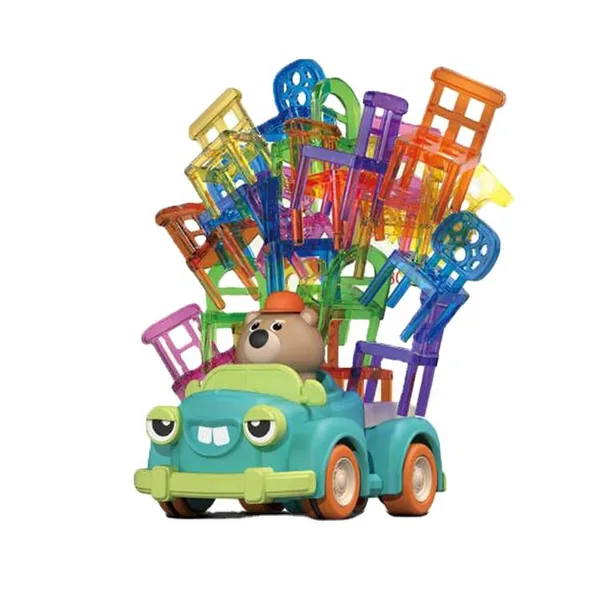
Puzzle toy wholesale prices vary widely by material, complexity, and order volume. A simple plastic puzzle (e.g., a truck stacking chair set) might be around $4.21 per unit with an MOQ of 24 units. A wooden CVC word game for early literacy could be about $4.89 with an MOQ of 32 units. A more complex electronic puzzle with flashcards could be $11.40 at an MOQ of 60 units. Fidget-style push-pop puzzles are cheaper — around $1.85–$2.21 — but require higher MOQs (120+ units). A 3D ball maze puzzle might be $2.00 but with an MOQ of 600 units.
These figures are indicative, not fixed; actual pricing depends on your volume, packaging, and customization. For OEM (custom branding), expect the MOQ to rise, often to 500–1,000 units per SKU, and add a mold or setup fee if you need a new shape. Always ask for a full quote that includes packaging, carton dimensions, and any test costs — some factories include testing in the price, others charge extra.
Puzzle Toy Supplier Types: A Quick Comparison
| Plastic puzzle factory (Chenghai) | Specialty: Injection-molded puzzles, fidgets, logic games | MOQ: 24–600 units depending on product | OEM/ODM: Usually yes | Certifications: ASTM F963, CPSIA, CE on request |
|---|---|
| Wooden puzzle factory (Shantou area) | Specialty: Montessori-style puzzles, spelling games | MOQ: 30–500 units | OEM/ODM: Yes, but higher setup for custom shapes | Certifications: EN71, ASTM F963 typically available |
| Educational toy trading company (Yiwu) | Specialty: Low-cost novelty puzzles, bulk assortments | MOQ: 100–1,000 units | OEM/ODM: Limited | Certifications: Varies by spec; verify before ordering |
| Full-service educational toy manufacturer (Chenghai) | Specialty: Classroom-ready puzzle play, sensory, and STEM assortments | MOQ: Low per SKU (24–120) | OEM/ODM: Yes, with packaging support | Certifications: CPC, ASTM F963, EN71 coordination |
What design files do I need for custom puzzle packaging?
If you want retail-ready packaging with your own branding, most Chinese factories will accept print-ready files in AI or PDF format. The common requirements are: a 3mm bleed on all sides, a safe margin of at least 5mm from the edge to keep text clear, and a color profile of CMYK (not RGB). For a simple box or polybag, you may also need to provide the barcode (UPC or EAN) and any required warning labels (e.g., 'small parts, not for children under 3').
Some factories offer in-house design services for an extra fee, but it is faster and cheaper if you provide a clean file. Ask the factory for their specific template before you pay for printing — they will often send a dieline (a cut-line template) so your artwork matches their box dimensions. If you are not sure about file requirements, request a proof before mass production; this is a standard step in OEM orders.
How to verify a puzzle toy factory before you order
Verification is about evidence, not promises. Start with a factory audit — you can do it yourself or hire a third-party inspection company. The audit should check production capacity (how many units per day), quality control processes (incoming material checks, in-line QC, final random inspection), and compliance documentation (test reports, CPCs, material safety data sheets). Ask to see the actual production line, not just the showroom.
Next, request samples — at least one pre-production sample and one from the actual production run. Compare the sample to the spec sheet: weight, size, color, edge finish. For classroom use, do a 'drop test' yourself: drop the puzzle from a desk height a few times to see if pieces break or create sharp edges. Also check the packaging: is it sturdy enough for a classroom shelf? Does the age grade and warning label appear on the box?
Finally, ask for references — other distributors or school suppliers who have ordered similar products. A factory that has supplied classroom toys to the U.S. should be able to share case studies or contacts (with permission). If they cannot, treat that as a caution. And remember: a mold is not automatically transferable to another factory just because you paid for development; transfer conditions should be written into your contract.
Puzzle toys for classrooms: a practical checklist for your next order
Before you place your next wholesale order, run this checklist: 1. Age grade: Confirm the product’s intended age (e.g., 3+, 5+, 8+). Does it match your classroom’s age group? 2. Small parts: For under-8 classrooms, ensure pieces are larger than the small-parts cylinder, or the toy is labeled for older kids. 3. Safety certs: Request a test report for ASTM F963 (US) and EN71 (EU). For the US, you need a CPC if the toy is for under-13. 4. Durability: Choose materials that withstand daily use — ABS or HDPE for plastic puzzles, smooth-sanded wood for wooden ones. 5. OEM design: If you need custom packaging, prepare AI/PDF files with 3mm bleed and safe margins, and get a proof before mass production. 6. MOQ and lead time: Clarify the MOQ and lead time in writing — they vary by product complexity. 7. QC: Arrange a pre-shipment inspection to catch defects before your container leaves port. If the factory cannot answer these points clearly, find another supplier.
FAQ: Sourcing Puzzle Toys for Classroom Programs
What is the typical MOQ for custom puzzle toys from China?
MOQs vary by product complexity. A simple plastic puzzle might have an MOQ of 24–72 units, while a 3D maze puzzle or custom OEM item could require 600 or more. Always ask the factory for the MOQ for your specific SKU, and expect higher MOQs for custom packaging or new molds.
Which certifications do puzzle toys need for the US and EU markets?
For the US, puzzle toys intended primarily for children 12 and under must comply with ASTM F963 under CPSIA and have a Children’s Product Certificate (CPC). For the EU, EN71 is the relevant standard. Ask the factory for test reports from a recognized lab for both standards if you sell into both markets.
How can I check if a puzzle toy is safe for a 3-year-old classroom?
Check the age grade on the product and ensure it says 3+ or higher. For under-3, small parts are banned; for ages 3–5, pieces should be large enough to not fit entirely into a small-parts cylinder. Also verify the product passes ASTM F963 small parts and sharp edge tests, and request a sample to inspect edges and piece size yourself.
What design files do I need for custom puzzle packaging?
Most Chinese factories accept print-ready AI or PDF files with a 3mm bleed and a safe margin of at least 5mm. Use CMYK color mode and include your barcode (UPC/EAN) and any required warning labels. Ask the factory for their dieline template before finalizing the artwork.
How do I compare puzzle toy suppliers from Chenghai vs Yiwu?
Chenghai/Shantou is the toy manufacturing hub with access to mold makers and compliance labs, making it better for educational puzzles with testing and OEM needs. Yiwu is a trading hub for lower-cost novelty items but may have limited OEM and certification support. For classroom-grade products, prioritize suppliers in Chenghai/Shantou.
What should I check before placing a large puzzle toy order?
Verify the factory’s certification documents (CPC, test reports), request pre-production samples, confirm MOQ and lead time in writing, and arrange a pre-shipment inspection. Also check the material durability for classroom use — ABS or HDPE for plastic, and smooth wood for wooden puzzles.
Sources
Related Products & Categories
Request a Quote for Classroom-Ready Puzzle Toys
If you are sourcing puzzle toys for a classroom program or school supply catalog, send us your target age group, quantity, and destination market. We can provide SKU data, MOQ guidance, OEM packaging options, and compliance document coordination for ASTM F963 and EN71. Request a quote and we’ll help you evaluate which puzzle toys fit your program.