
Fine Motor Skills Toys: Choose Product vs. Packed Dimensions
Compare assembled size, classroom workspace, retail-box size, and carton size using an 81-piece track-car set and a 23-piece bucket-truck set.
For classroom construction sets, use assembled product dimensions to approve the learning station and packed dimensions to approve storage and handling. Fine motor skills toys also need working space for loose pieces and hands—not just room for the finished model. Compare an 81-piece track-car set with a 23-piece bucket-truck set by assembly task first, then measure the usable build, classroom workspace, individual box, and shipping carton separately. Never substitute one measurement for another.
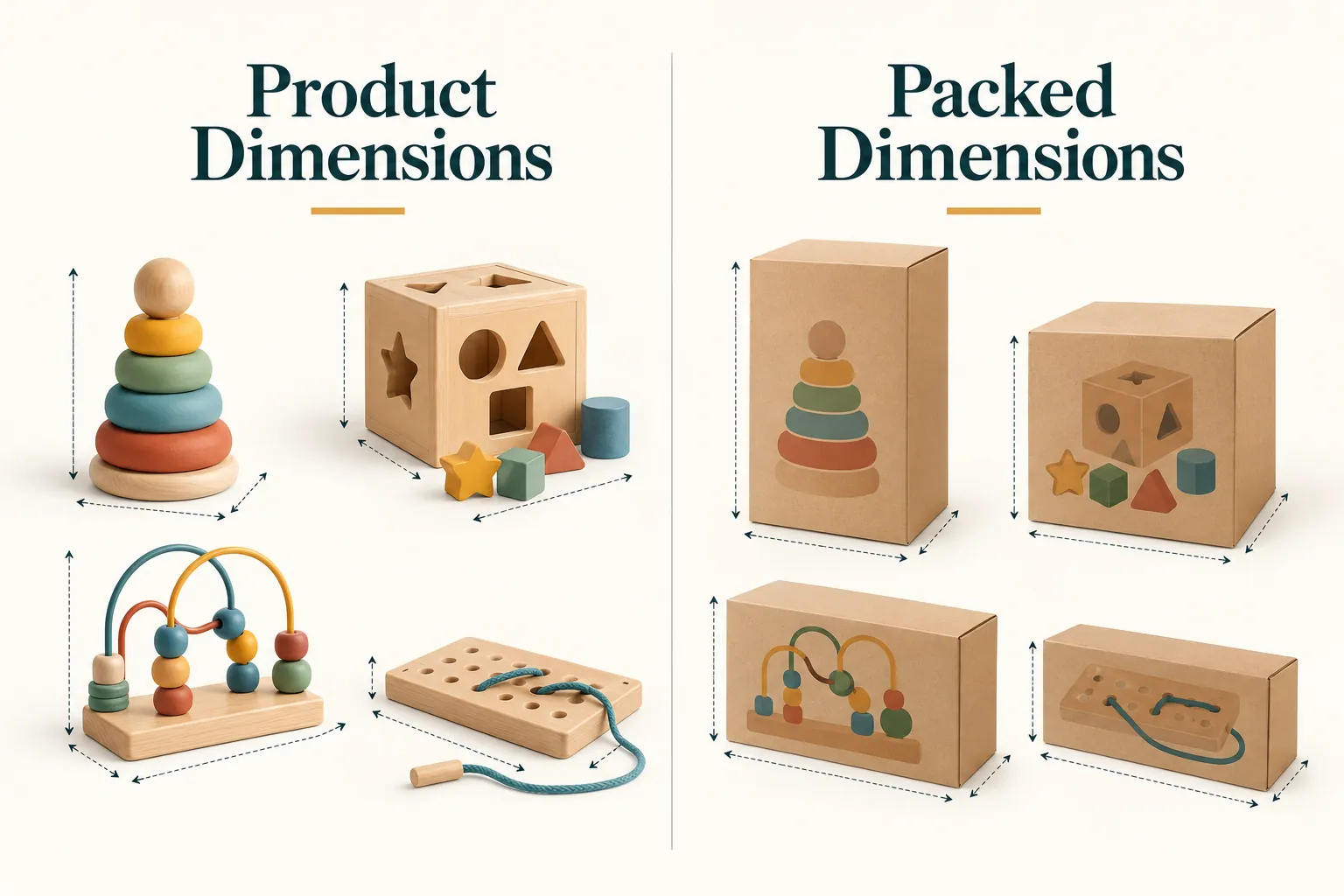
Which construction set matches the intended classroom activity?
| 81-piece DIY 3D building-block track-car set | Catalog reference: CPS342092. Recorded material: ABS. Packing: color box. Proposed activity: assembling the track-car model. For dimension review, define the model configuration to be built and include any track layout used in the intended activity. |
|---|---|
| 23-piece building-block bucket-truck set | Catalog reference: CPS291353. Recorded material: biofibre straw. Packing: window box. Proposed activity: assembling a bucket-truck model. Measure the finished model in its intended use position and check any movement clearance during the sample review. |
Which dimensions belong in the classroom, shelf, and shipping fields?
Keep assembled product size, classroom working space, individual packed size, and outer-carton size in separate fields because each answers a different purchasing question.
Product dimensions describe the unpacked toy in a defined usable configuration. An Amazon seller-forum reply makes the same distinction between a functioning unpacked product and the product in its packaging; this is terminology guidance, not a toy-specific requirement or platform-policy ruling. Amazon Seller Forums
For a construction set, record the assembled model and identify the build shown in the instructions or sample photograph. If alternative builds are offered, label each measured configuration rather than publishing one unexplained size. For the track-car activity, distinguish the car alone from any complete track layout used.
Classroom working space is a separate buyer measurement: lay out the pieces, instructions, and sorting container as they will be used, then measure the occupied station. A finished model can fit on a desk while its assembly activity does not.
Individual packed dimensions are the outside measurements of one closed color box or window box. Use them to check shelf and storage-bin fit in the intended orientation. Outer-carton dimensions describe the shipping carton containing multiple sets; keep them separate for warehouse and transport planning. Neither measurement establishes the toy’s classroom suitability.
How many children can share a set?
Plan sharing around independent builds and access to components, not the total number of pieces.
For the initial sample review, treat each set as one build station. This is a proposed planning basis, not a manufacturer-rated learner capacity. Increase the planned group size only after observing whether learners can participate in the intended task without competing for the same essential components.
An 81-piece set does not automatically support more simultaneous builders than a 23-piece set. Check whether the activity produces one shared model or several independent models, which parts each learner needs, and where pieces must remain accessible. Record the intended learner count beside the measured working-space footprint.
Choose the learner group using the product’s age guidance and the intended task before conducting a classroom trial. Box size, material name, and piece count are not substitutes for that decision.
What should the product-versus-packed dimension worksheet record?
| Track-car set — CPS342092 | Recorded identity: 81 pieces; ABS; color box. Proposed classroom use: a track-car assembly station. Sharing entry: record the intended learner count and observed access to essential components. Product measurement: record the assembled car and, where used, the complete track layout as distinct configurations. Workspace measurement: record the occupied assembly area with loose parts and instructions. Packed measurements: record the closed individual box and outer shipping carton separately. Approval note: select for the track-car activity only when the chosen build and working layout fit the assigned station and the packed box fits the storage allocation. |
|---|---|
| Bucket-truck set — CPS291353 | Recorded identity: 23 pieces; biofibre straw; window box. Proposed classroom use: a construction-vehicle assembly station. Sharing entry: test the intended learner count against component access rather than assuming capacity from 23 pieces. Product measurement: record the assembled truck in its intended use position and check movement clearance where applicable. Workspace measurement: include the loose components and instructions used during assembly. Packed measurements: measure the closed window box and outer shipping carton independently. Approval note: choose for the vehicle-building activity only when the model, assembly area, and packed storage fit their specified limits. |
| Decision and handoff record | For each set, retain the product reference, sample identity, packaging revision, specified limits, observed measurements, and decision: approve, approve with conditions, or revise. Name the responsible buyer or approver and record the decision date. Assign each condition an owner and closure date, then retain the remeasurement or other evidence used to close it. |
When should the buyer approve the dimension comparison?
Approve the dimension comparison only after measurements for the current sample and packaging revision show that the intended activity fits its classroom allocation and each packaging level fits its own storage or handling requirement. Keep buyer-specified limits separate from measured results; a requested maximum size is not evidence that the sample meets it.
The following dimension fields remain unresolved for each SKU. An unlabeled catalog size does not establish whether it describes the assembled toy, individual box, or outer carton; confirm its units and measurement level rather than copying it into all three fields.
If the assembled model fits but the loose-parts layout does not, change the station arrangement or select a different activity; a smaller retail box will not solve the classroom-space problem. If the activity fits but the closed box does not fit the shelf, address the packaging or storage allocation without changing the product-size record.
For both SKUs, also obtain or confirm the current sample and its match to the offered item, age and skill guidance for the intended learners, and item-specific safety evidence and documents applicable to the destination. These remain unverified; neither material nor piece count establishes suitability. Confirm these matters before any learner trial.
Before order approval, request a current quote covering price, MOQ, packing configuration, units per carton, availability, and delivery terms. The catalog records reference MOQ 18 and 18 units/carton for CPS342092, and reference MOQ 72 and 24 units/carton for CPS291353; these are recorded references, not guaranteed current order terms.
Keep both SKUs pending until their dimension fields are completed and checked against the stated limits. Record the intended sharing count and the sample-review result rather than treating a proposed group size as demonstrated capacity. Assign each unresolved item an owner and closure date, and retain the measurements or documents used to close it. Dimensional approval may then be recorded separately; overall purchasing approval still requires resolution of the applicable age, safety, sample, and commercial questions.
Keep dimensional approval limited to dimensional fit. It is not an age-suitability decision, safety assessment, or freight quotation. The review record preserves what was measured and approved; it does not by itself detect a later, undisclosed product or packaging change.
| CPS342092 — dimensions still to confirm | Assembled car length × width × height; complete track-layout dimensions if used; assembly workspace with loose pieces and instructions at the intended learner count; closed color-box outside dimensions; outer-carton outside dimensions. Record units, configuration, sample identity, packaging revision, and measurement date. |
|---|---|
| CPS291353 — dimensions still to confirm | Assembled bucket-truck length × width × height in the intended use position, including movement clearance where applicable; assembly workspace with loose pieces and instructions at the intended learner count; closed window-box outside dimensions; outer-carton outside dimensions. Record units, configuration, sample identity, packaging revision, and measurement date. |