
Joyreal Busy Board: How to Check Fine-Motor Toy Samples
Use the Joyreal mirror recall to frame busy-board sample checks, separate observations from lab testing, and record approval conditions.
Approve a busy-board sample only after comparing its component attachment, finish and function with the agreed written specification—not because it passes a hand check. For buyers of fine motor skills toys, the February 26, 2026 Joyreal Busy Board recall supplies two specific review questions: could a comparable mounted component detach, and could its edges become accessible? Match the component first, record observable discrepancies, and refer safety conclusions to qualified testing before closing the sample decision.
What failure mechanism did CPSC publish for Joyreal Busy Board Toys?
CPSC identified a small mirror that could detach and a mirror with sharp edges in the recalled Joyreal Busy Board Toys. Its February 26, 2026 US notice states that the detachable mirror violates the small parts ban and poses a deadly choking hazard; it also states that the mirror’s sharp edges violate the mandatory standard for toys and pose a laceration hazard. These are findings about the named recalled units, not findings about busy boards generally. CPSC recall notice
The recalled configuration included a mirror alongside LED lights, a power switch, a brightness knob, keys, an electrical cable and a hand crank. The useful purchasing lesson is component-specific: review how an accessible mounted part is retained and how its edge is protected. The notice does not establish whether an adhesive, fastener or another attachment detail caused the mirror to detach.
This is a historical external case. It establishes no connection to the catalog examples below or their suppliers. An actual recalled Joyreal unit is not a candidate for approval through this sample-review process; follow the CPSC recall instructions instead.
Which catalog example supports the busy-board comparison?
The Small Appliances Busy Board is the closer play-mechanism comparison; the pretend-play tool toy is not an interchangeable busy-board example. Neither example includes the recalled mirror component, so transfer the general attachment-and-edge questions—not an allegation of a mirror defect. Confirm the delivered sample’s component inventory before applying the review.
| Small Appliances Busy Board | Recorded material: ABS plastic. Packing: color box. Use the busy-board format to frame questions about mounted parts and their operation. Match each actual component to the agreed drawing or component list before deciding which checks apply. |
|---|---|
| Pretend-Play Tool Toy | Recorded material: plastic. Packing: color box. Its tool-based play mechanism calls for checks of the supplied tools, accessories and intended actions. Do not assume it shares the Joyreal board’s switches, crank or mirror. |
| Mirror-specific boundary | The mirror is absent from these examples. Do not record a mirror attachment or mirror-edge result for a toy without one. If a mirror appears on the delivered sample, reconcile that construction with the agreed specification and review its testing needs. |
What should buyers compare before first sample approval?
Compare the first physical sample with the agreed written specification and design requirements; create the approved production reference only after that review is complete. A sample cannot serve as its own acceptance criterion.
Have the current drawing, component list, material requirements, function description, dimensions and packaging artwork available at the review. For a classroom purchase, also define the intended learner group, the fine-motor actions required and the proposed sharing arrangement. Turning a control, grasping a handle and fitting a tool are different tasks; count usable activity positions rather than assuming every mounted feature supports another child.
Use an adult review to assess access, tabletop stability and whether simultaneous actions interfere with each other. That can inform a classroom-use decision, but it does not establish safe age suitability or validate a claimed number of simultaneous users.
Which sample questions reveal a discrepancy worth holding?
Hold approval when an observed condition conflicts with the agreed design or raises an unresolved attachment or edge concern. The following checks are purchasing observations, not compliance tests.
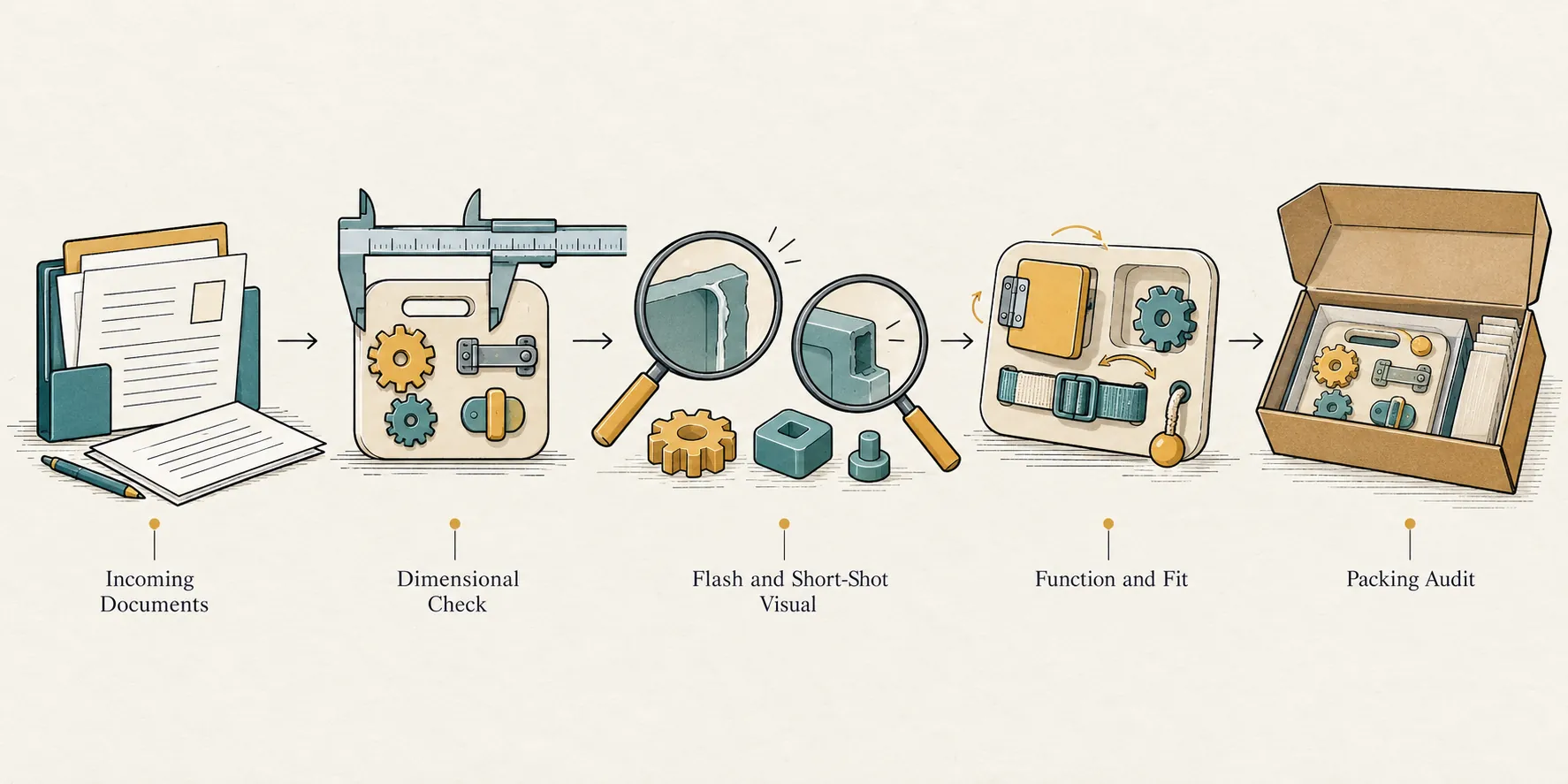
| Does the component inventory match? | Inspect: mounted controls, covers, accessories and their locations. Compare: component list and design revision. Failure signal: an added, missing or substituted part. Next decision: reconcile the construction and obtain written acceptance or a corrected sample before approval. |
|---|---|
| Does each part perform its intended action? | Inspect: operate each supplied feature as described in the instructions, without improvised force or destructive testing. Compare: written function requirements. Failure signal: binding, unintended housing movement, a loose part or loss of the specified function. Next decision: stop the affected check, identify the location and request correction or technical review. |
| Does the visible attachment match the design? | Inspect: seating, gaps, visible fasteners and movement of the mounting relative to the base. Compare: attachment drawing and assembly requirements. Failure signal: a lifted corner, an omitted visible fastener or movement where the design calls for a stationary mounting. Next decision: hold the feature for clarification and determine whether qualified testing is needed. |
| Are finish and accessible edges consistent with the requirements? | Inspect visually for cracks, chips, burrs, protruding hardware, lifted trim or an exposed edge. Compare: finish requirements and edge-protection design. Failure signal: damage or a departure from the specified protection. Next decision: isolate the sample from child use and refer the concern for correction and, where appropriate, qualified evaluation. Do not use a finger or skin as a sharp-edge test. |
| Do materials and dimensions match the agreement? | Inspect: visible construction and measured overall and critical component dimensions. Compare: material requirements, drawing dimensions and agreed tolerances. Failure signal: a dimensional mismatch or a visible construction change. Next decision: document actual measurements and resolve the discrepancy. Appearance alone cannot establish polymer identity or chemical composition. |
| Does the agreed packaging match the sample? | Inspect: color box, product identification, instructions, artwork revision, accessory count and protection of projecting parts. Compare: approved packaging requirements and packing list. Failure signal: inconsistent identification, incorrect contents or packaging damage affecting the toy. Next decision: correct the packaging or product issue before closing the review. |
Which questions require qualified testing rather than a hand check?
Qualified testing is needed to determine whether the relevant construction satisfies applicable small-parts, attachment and sharp-edge requirements; visual inspection cannot answer those questions. Ask a qualified laboratory to identify the applicable procedures for the actual toy, intended age and destination, including relevant conditioning or use-and-abuse procedures.
The request should identify the component, its attachment arrangement and the concern: for example, whether a mounted part becomes detached under the specified procedures, whether a resulting part meets the applicable small-parts criteria, or whether an accessible edge fails the applicable sharp-edge assessment. Do not replace those procedures with an invented pliers test, an arbitrary pull or a buyer-selected repetition count.
Match any report to the tested construction and assess whether subsequent changes affect its coverage. A different internal item number does not automatically require a new test, and a visually similar sample does not automatically fall within an existing report. Keep destination-specific documentation review separate from this physical sample record.
What happens when a mounted control moves unexpectedly?
Unexpected mounting movement warrants a hold on that feature, not an immediate declaration that the toy violates a safety rule.
Consider an illustrative review in which the agreed drawing calls for a stationary control housing, but the housing rocks while the control is operated normally. Record the requirement and the observed movement separately. Ask the supplier whether the movement is intended, request the relevant assembly detail, and obtain a corrected sample if the construction departs from the agreement. If the concern involves retention or an accessible edge, route the safety question to qualified testing.
If the movement is demonstrated to be intentional and acceptable, revise the written requirement through a controlled approval rather than silently accepting the discrepancy. Either route needs a recorded closure before the sample becomes the production reference.
What belongs in the sample approval record?
A useful sample record connects the exact sample and specification revision to observations, open conditions and a dated approval decision. Use the following fields as a review form; enter actual findings rather than treating the prompts as completed inspection results.
| Identity and revision | Record the product name, supplier, item identifier, sample ID, receipt date, specification revision, drawing revision and packaging artwork revision. |
|---|---|
| Mechanism and component match | Identify the actual play actions and mounted components. Record whether a mirror is present and which Joyreal-derived questions apply. Exclude component-specific questions that do not match. |
| Specified target versus observation | For each reviewed feature, enter the written target, actual observation or measurement, inspection method and exact location. Reference photographs where useful; a missing photograph alone does not invalidate an otherwise traceable review. |
| Testing and clarification | List the question requiring laboratory evaluation, relevant report references, supplier explanations and any construction changes requiring assessment. |
| Decision and responsibility | Record approved, held or rejected status; unresolved conditions; the responsible reviewer and approver; and their decision dates. Keep a conditional decision distinct from final approval. |
| Follow-up closure | Assign an owner and due date to each action. Record the corrected sample or revised document, recheck result, relevant testing outcome and dated closure authorization. |
| Approved production reference | After approval, label and retain the reference sample with its approved specification revision and retention location. Preserve subsequent change approvals alongside it. |
How should bulk production be compared after approval?
Compare bulk production with the approved written specification, retained reference sample and authorized change records together. The retained sample complements those records; it is not the only valid basis for inspection.
Recheck component identity, attachment appearance, operation, finish, dimensions and agreed packaging. Investigate deviations before accepting the affected goods, and assess whether a construction change requires further testing. A signed sample record supports traceability, but it does not by itself reveal an undisclosed production change.