
How to Specify Packout for Classroom Fine-Motor Toys
Define the quoted unit, children per set, complete contents, and carton count before approving busy cube or pretend-play tool toy quotes.
Define packout for classroom fine motor skills toys by specifying one complete activity unit, how many children use it at once, and how those units are packed and quoted. For a busy cube, use one cube per active child as the planning basis; for a pretend-play driller toy, distinguish one complete tool set from a box containing several sets. Approve the quote only when its unit of sale and carton count match that classroom configuration.
Packout means the exact contents and quantities at each packaging level—not simply “single item,” “color box,” or “classroom set.” Those descriptions alone do not establish how many complete activities the school receives.
What does each toy do, and how many children should one pack serve?
Plan one active user per busy cube or complete driller activity unless a sample review demonstrates that the intended activity supports more simultaneous users.
The busy cube is an activity-board-style manipulation toy. Its catalog packing is “single item,” and its recorded material is ABS. Specify one complete cube as the activity unit; inspect the sample to identify its actual manipulation features rather than assuming particular locks, switches, or removable parts.
The driller toy is a pretend-play tool activity with plastic recorded as its material and a color box recorded as its packaging. A color box describes the package, not the number of complete tool sets or independent work positions inside it. List the tool, accessories, and other included components against the sample before calling the box a complete activity set.
Keep simultaneous users separate from scheduled users. A buyer may assign two children to take turns with one set, but that remains one active work position—not two. Choose individual activity units when all children need hands-on access at once; use shared sets when turn-taking is part of the planned activity.
State the intended class age band and task alongside the sharing plan, then review the sample and applicable age information before approving that use. Product names and material labels do not establish age suitability or classroom capacity.
What should the packout worksheet specify for each toy?
The worksheet should separate catalog reference fields from the buyer’s proposed classroom configuration and the supplier’s sample-backed quotation.
The following comparison uses the catalog references dated October 9, 2026. Sharing arrangements are proposed purchasing specifications, not verified product capacities. Reference MOQs are starting points for quotation confirmation, not current offers.
| Busy cube activity toy | Mechanism: activity-board-style busy cube. Recorded material: ABS. Proposed sharing unit: 1 complete cube for 1 active child. Recorded pack type: single item. Recorded carton quantity: 100 units/carton. Reference MOQ: 200 units. Proposed quoted unit: 1 complete cube. Status: material, packing, carton quantity, and MOQ are catalog references; confirm current terms, individual wrapping or container, included contents, and that each carton unit means 1 complete cube. |
|---|---|
| Pretend-play driller tool toy | Mechanism: pretend-play tool activity. Recorded material: plastic. Proposed sharing unit: 1 complete activity set for 1 active child; optionally assign 2 children to take turns. Recorded pack type: color box. Reference MOQ: 150 units. Proposed quoted unit: 1 color box containing 1 complete activity set. Status: material, packing, and MOQ are catalog references; confirm the complete contents, sets per box, complete sets per carton, and current commercial terms in the quotation. |
Should the quote use single activity units or multi-set classroom packs?
Request single activity units when schools distribute toys individually; request a multi-set classroom pack only when its contents are explicitly defined as several complete activities.
For a bounded comparison, consider a buyer-defined pack containing four busy cubes. If each cube supports the planned individual activity, the pack provides four active work positions. By contrast, four components inside one driller box do not establish four work positions: they may all be needed for one activity. Count complete usable activities, not loose pieces.
A proposed four-set driller classroom pack should therefore mean four complete sets, each matching an approved contents list. It must not mean one set with four accessories. Request that configuration as a separate quotation option rather than treating it as an existing catalog offer.
Compare prices per complete activity unit on the same contents and packaging basis. If suppliers quote different pack sizes, divide each pack price by its number of complete activity units before comparing. Retain the pack price as well, since individual boxes and a shared outer container are different deliverables.
What must the sample and quote confirm before packout approval?
The sample and quote should confirm the same complete contents, packaging hierarchy, and unit definitions before the buyer accepts the packout.
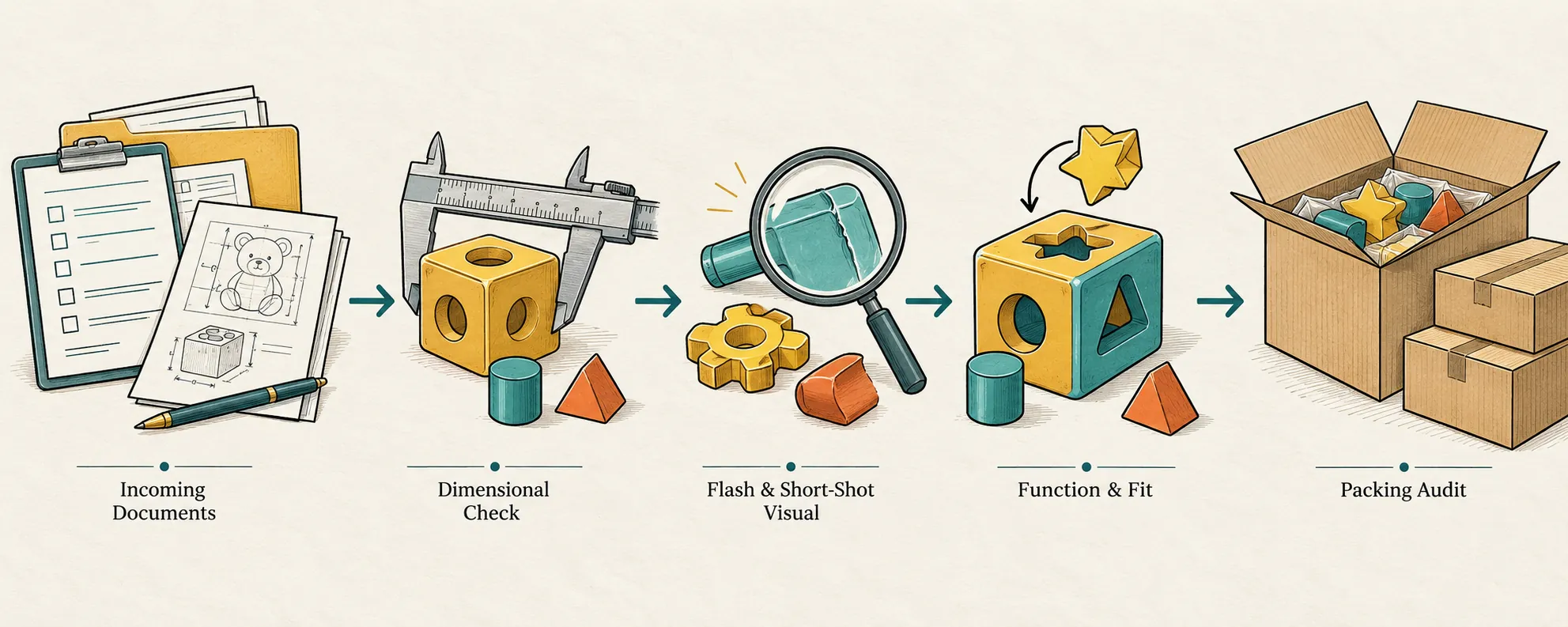
Unpack the proposed sale unit and count its contents against the requested activity. For the cube, verify what accompanies the cube and how it is individually packed. For the driller activity, record each included component and check that one quoted set contains everything specified for the planned task. Photograph the laid-out contents and the closed package, and identify both by sample revision.
Write the packaging hierarchy explicitly: complete activity units per sale pack, sale packs per inner pack if used, and sale packs or complete units per master carton. State which measure appears beside the quoted price and MOQ. For the busy cube, reconfirm that the recorded 100 units/carton refers to complete cubes; for the driller toy, request the carton count in complete sets.
Keep MOQ and carton quantity separate. A minimum order does not establish an order multiple, and a carton count does not automatically require full-carton purchasing. Request any full-carton restriction explicitly before treating it as an ordering condition.
These are commercial contents and packaging checks. They do not replace product safety testing or establish suitability for a particular age group.
Packout approval record
Approve packout against an identified worksheet revision, with the specified target, observed configuration, decision, and closure responsibility recorded together.
Use the two-product worksheet above as the attachment to the quote request. Before accepting the final quote, complete this approval record for each product. Conditional approval may support continued quotation work, but it should not be treated as final acceptance while a condition affecting contents, price basis, or carton count remains unresolved.
| Identity and revision | Product name and supplier item reference: ____; packout worksheet ID/revision: ____; sample ID/revision: ____; quote number/revision: ____. |
|---|---|
| Classroom target versus sample observation | Target: ____ complete activity units per pack; ____ active children per unit; ____ children assigned per unit, including turn-taking. Observation: ____ complete activity units counted; included contents: ____; sample-review notes against the planned task: ____. |
| Packaging target versus quoted configuration | Target: ____ activity units per sale pack; ____ sale packs per inner pack, if used; ____ sale packs or activity units per master carton. Quoted configuration: ____. State the counting unit at every level. |
| Commercial unit confirmation | Price applies to: ____; current MOQ and its counting unit: ____; any expressly agreed order multiple or full-carton restriction: ____. |
| Decision and responsible approver | Decision: approve / approve with conditions / revise. Conditions and affected quote lines: ____. Responsible buyer approver: ____; approval date: ____. |
| Follow-up and closure | Required correction or confirmation: ____; responsible person: ____; due date: ____; closing sample, photograph, or revised quote reference: ____; closure accepted by: ____; closure date: ____. |