How to Choose Educational Toys Wholesale: Turn Materials and Design into an Evidence-Led Component Review
A component review framework for evidence-led classroom selection: materials, design, ASTM F963 checks, and supplier files before you order wholesale.
A materials and design decision for evidence-led classroom selection should be based on comparable product and supplier evidence — not on a catalog photo. For a wholesale buyer comparing learning claims and supplier files, the practical test is a component review: check the paint and substrate limits, small parts, sound output, cords, magnets, and expanding materials against the mandatory U.S. standard ASTM F963 before you commit to a container. The next buyer action is to request a Children's Product Certificate (CPC) and the applicable third-party test report for every toy intended for children 12 and under, and to keep that file next to the purchase order. This guide walks through the material and design questions that make that review fast and repeatable.
Key Takeaways
- For toys intended primarily for children 12 and under, require a CPC and third-party test report; for toys aimed at children 13 and older, the testing and certification requirement does not apply under the U.S. framework.
- Age grading drives the review: toys for under-3s must not release small parts, and toys for under-8s must not have hazardous edges, points, or puncture hazards before and after use-and-abuse testing.
- Material choice is a compliance decision at the resin stage, not an end-of-production test — confirm BPA-free and phthalate-free status and material traceability with the supplier before molding.
- Sound-producing toys have specific design limits; a single fidget SKU does not serve every classroom, so specify the use environment (quiet library vs. outdoor) in your brief.
- Ask the supplier to identify which ASTM F963 sections apply to each SKU — not all sections apply to all toys, and a generic test report is not evidence.
OEM vs. ODM vs. Stock + Logo for Educational Toys
| OEM (Your design) | You provide the design and spec; factory engineers the mold and process. Highest control over materials and design evidence. Tooling cost applies; MOQ is typically higher. Lead time includes mold making. |
|---|---|
| ODM (Our design + your brand) | Factory's existing design with your logo and packaging. Material and design are already proven; you verify the existing test reports. Lower MOQ; no new tooling unless you change the design. |
| Stock + Logo | Factory's finished stock with your label applied. Fastest route; lowest MOQ. You inherit the factory's compliance files as-is; your component review is a document check, not a design change. |
What Can You Customize in an Educational Toy Component Review?
Color, size, material, packaging, logo, and private label are the standard levers. The more important customization is the design file: you can specify the material grade, the sound output cap, the absence of magnets, or the cord length, and those choices change which ASTM F963 sections apply.
On material, the supplier's choice is not neutral. ABS offers strong impact resistance and dimensional stability for rigid parts; PP is lightweight and cost-effective with faster cycle times; LDPE is more flexible and suits squeezable components; HIPS modifies the brittleness of general-purpose polystyrene for rigid parts. Silicone and TPE are preferred for infant sensory toys for softness and sterilizability, but they carry higher costs and slower cycles. The right choice depends on the target market certification, the use environment, and the total manufacturing cost — mold design, cycle time, and scrap rate — not just the per-kilogram resin price.
On packaging and branding, common design file requirements include print-ready artwork with bleed, color profiles, and die-cut lines for retail-ready boxes. Confirm these with the supplier before sampling to avoid a redesign cycle that delays your lead time.
MOQ, Tooling & Mold: What Minimum Order Quantities and Pricing Tiers Should You Expect?
MOQ bands vary by product type and customization route. For stock or ODM items with existing molds, MOQs are typically lower and pricing tiers are set by volume. For OEM with new tooling, the MOQ is higher because the mold cost must be amortized across the first production run. Actual numbers must be confirmed per spec — never assume a catalog MOQ applies to a custom design.
A new mold is a capital cost that only makes sense when your volume justifies it. If you own the design and expect repeat orders, OEM gives you control over materials and design evidence. If you need speed and a low MOQ, Stock + Logo avoids tooling entirely. Ask the supplier directly: Is the MOQ for this SKU based on an existing mold or a new tool? What is the tooling cost, and is it amortized into the unit price or charged separately?
For pricing tiers, request a volume break schedule (e.g., 500, 1,000, 5,000 units) in writing. The per-unit price should reflect the material grade, the cycle time, and the assembly labor — not just the resin cost. A cheap per-kilogram price can be offset by a slow cycle or high scrap rate.
Sampling & Lead Time: What Are the Typical Lead Times for Bulk Orders from Asia to a US Distribution Center?
Lead time has two parts: pre-production (sampling, mold making, and approval) and production (mass production and QC). For a stock or ODM item, sampling can take a few days to a couple of weeks. For an OEM item with a new mold, mold making dominates the pre-production timeline and can take several weeks. Shipping from Asia to a US distribution center adds transit time, which varies by port and shipping method (air vs. sea).
Ask the supplier for a timeline breakdown in writing: sample lead time, mold lead time (if applicable), production lead time, and estimated transit time. The sample approval is your checkpoint — do not start mass production until the sample matches your component review checklist.
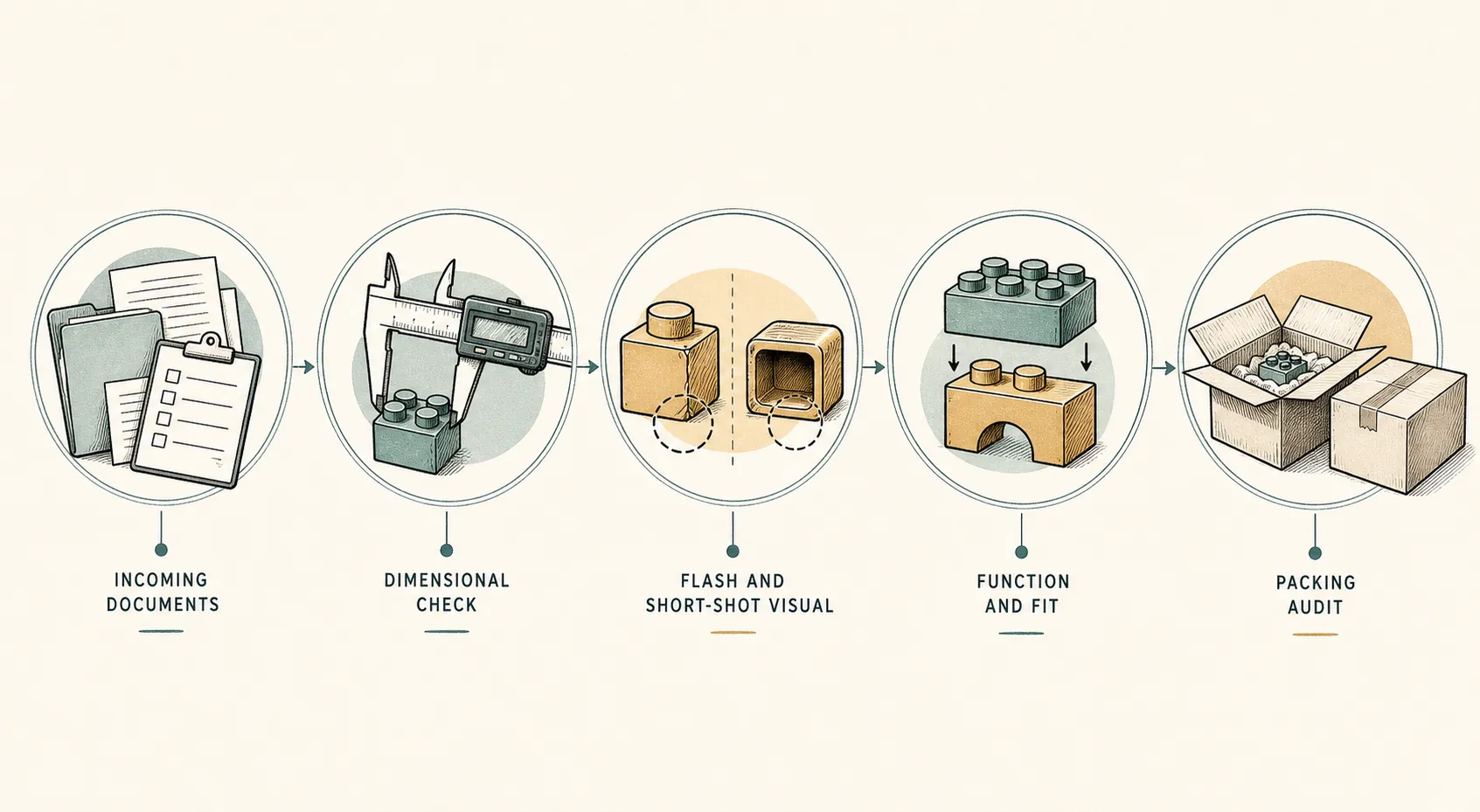
The sample is not just a visual check. Confirm the material grade, the sound output, the absence of small parts, and the packaging artwork on the physical sample, not on a photo.
The OEM/ODM Process (Step by Step)
The process a buyer runs with any factory has checkpoints and supplier questions at each step.
Step 1 — Inquiry and spec. Send your design file or your ODM interest with the target market (US vs. EU), the age grade, and the use environment. Ask: Which ASTM F963 sections apply to this design? This is the first evidence request.
Step 2 — Quotation. The factory returns a unit price, MOQ, and tooling cost (if any). Ask for the volume break schedule and whether the mold cost is amortized or separate. Confirm the material grade in writing.
Step 3 — Sampling and proofing. The factory produces a sample and packaging proof. Your checkpoint: does the sample match your component review checklist? Measure the sound output, check for small parts, and verify the material traceability document.
Step 4 — Mold and tooling (OEM only). If a new mold is required, this is a paid step. Confirm the mold ownership clause in writing — who owns the mold after production? Ask for a mold-making timeline.
Step 5 — Mass production. The factory orders the certified resin, molds the parts, and assembles. Your checkpoint: request a pre-production sample from the actual production line, not the engineering sample.
Step 6 — QC and inspection. Decide whether to use a third-party inspection. Your checkpoint: ask for the inspection report before shipment, and confirm the AQL (Acceptable Quality Limit) and sampling plan in advance. AQL and sampling are governed by the ISO 2859 series; confirm the specific level and limits with your supplier or inspector.
Step 7 — Shipping. Confirm the incoterms, port of loading, and transit time. For a US distribution center, confirm whether the CPC and test reports travel with the shipment or are sent electronically.
Worked Example (Illustrative, Not a Real Shipment)
A distributor orders 2,000 units of a sound-producing educational toy for a US classroom program. The order splits into two destinations: 1,200 units to a California DC and 800 units to a Texas DC. The supplier's standard SKU has a loud click. The buyer specifies a quieter click for the California portion (a library program) and keeps the loud version for Texas (outdoor use). The factory produces two samples. The quiet sample fails the buyer's internal sound check. The factory adjusts the click mechanism and re-samples before mass production. The hold point is Step 5: the pre-production sample from the actual line must match the approved quiet sample. If the line produces the loud version by mistake, the California portion is rejected at QC. This is a worked example to show where the hold point sits; it is not a record of a real shipment.
What Should Importers Check Before Sourcing STEM Toys Wholesale from China?
Before sourcing STEM toys wholesale, an importer's component review should cover four areas: material compliance, design hazards, documentation, and supplier traceability. On material, confirm the resin is BPA-free and phthalate-free at the compound stage, and ask for material traceability to a pre-certified compounder. On design, check small parts for under-3s, sharp edges and points for under-8s, sound output, cords and elastics, magnets (flux index below 50 for accessible magnets), and expanding materials. On documentation, require a CPC and third-party test report for toys intended for children 12 and under, and ask the supplier to list which ASTM F963 sections apply to each SKU. On traceability, ask whether the factory uses pre-certified compounders and whether material lots are traced through production.
For the EU market, the framework is different: EN71 and REACH apply, and the U.S. ASTM F963 certification is not a substitute. Confirm the destination market with the supplier before sampling, and request the corresponding EU documentation.
FAQ
What minimum order quantities and pricing tiers do Chinese suppliers typically require for educational toys wholesale?
MOQ bands vary by product and customization route. Stock or ODM items with existing molds typically have lower MOQs; OEM with new tooling has higher MOQs to amortize the mold cost. Pricing tiers are set by volume, so request a break schedule (e.g., 500, 1,000, 5,000 units) in writing. Actual numbers must be confirmed per spec.
What are the typical lead times and shipping costs for bulk educational toys wholesale orders from Asia to a US distribution center?
Lead time has two parts: pre-production (sampling, mold making, approval) and production (mass production and QC). Stock or ODM sampling can take days to weeks; OEM mold making takes longer. Shipping transit time varies by port and method (air vs. sea). Ask the supplier for a written timeline breakdown and confirm incoterms before ordering.
Can educational toys wholesale suppliers offer custom packaging and branding for retail-ready products, and what are the common design file requirements?
Yes, custom packaging and private label are standard. Common design file requirements include print-ready artwork with bleed, color profiles, and die-cut lines. Confirm these with the supplier before sampling to avoid a redesign cycle that delays lead time.
What should importers check before sourcing STEM toys wholesale from China?
Check material compliance (BPA-free, phthalate-free, traceability), design hazards (small parts, sharp edges, sound, cords, magnets, expanding materials), documentation (CPC and third-party test report for under-12s), and supplier traceability (pre-certified compounders and lot tracing). For the EU, require EN71 and REACH documentation — ASTM F963 is not a substitute.
What MOQ, pricing, and packaging details should buyers confirm for STEM toys wholesale?
Confirm the MOQ basis (existing mold vs. new tool), the volume break schedule, whether tooling cost is amortized or separate, the material grade, the packaging artwork requirements, and the incoterms. Also confirm which ASTM F963 sections apply to each SKU and request the corresponding test reports.
Who owns the mold in an OEM project, and will the factory sign an NDA?
Mold ownership is a contractual term. Confirm it in writing before paying tooling costs — it can be yours, the factory's, or shared. Most factories will sign an NDA to protect your design and IP, but confirm this early in the inquiry stage. Ask for the mold ownership clause and NDA in the quotation step.
Sources
Related Products & Categories
Request a Quote
Send your design file or spec sheet for a custom quote, including the target market, age grade, and use environment. The component review starts with the inquiry — the supplier should identify which ASTM F963 sections apply and provide the material traceability and test report evidence before you commit to a mold or a container.