
Fine Motor Toys Wholesale: Retail-Ready Packaging
Use packaging and merchandising evidence to decide if fine motor and sorting toys fit your early learning classrooms. A practical sourcing workflow.
Retail-ready packaging means cartons that move from the delivery dock to the shelf or classroom bin without rework: display-ready outer cartons, accurate barcodes, clear age grading, and labels that survive handling. For school suppliers and institutional buyers purchasing fine motor and sorting toys wholesale, the packaging and merchandising evidence you collect during sourcing—not the product photos—should decide whether a line fits your early learning classrooms program. Start your sourcing decision by asking suppliers for the packaging spec sheet alongside the unit price, because a low FOB price loses its appeal when you must repackage every carton before it reaches a teacher.
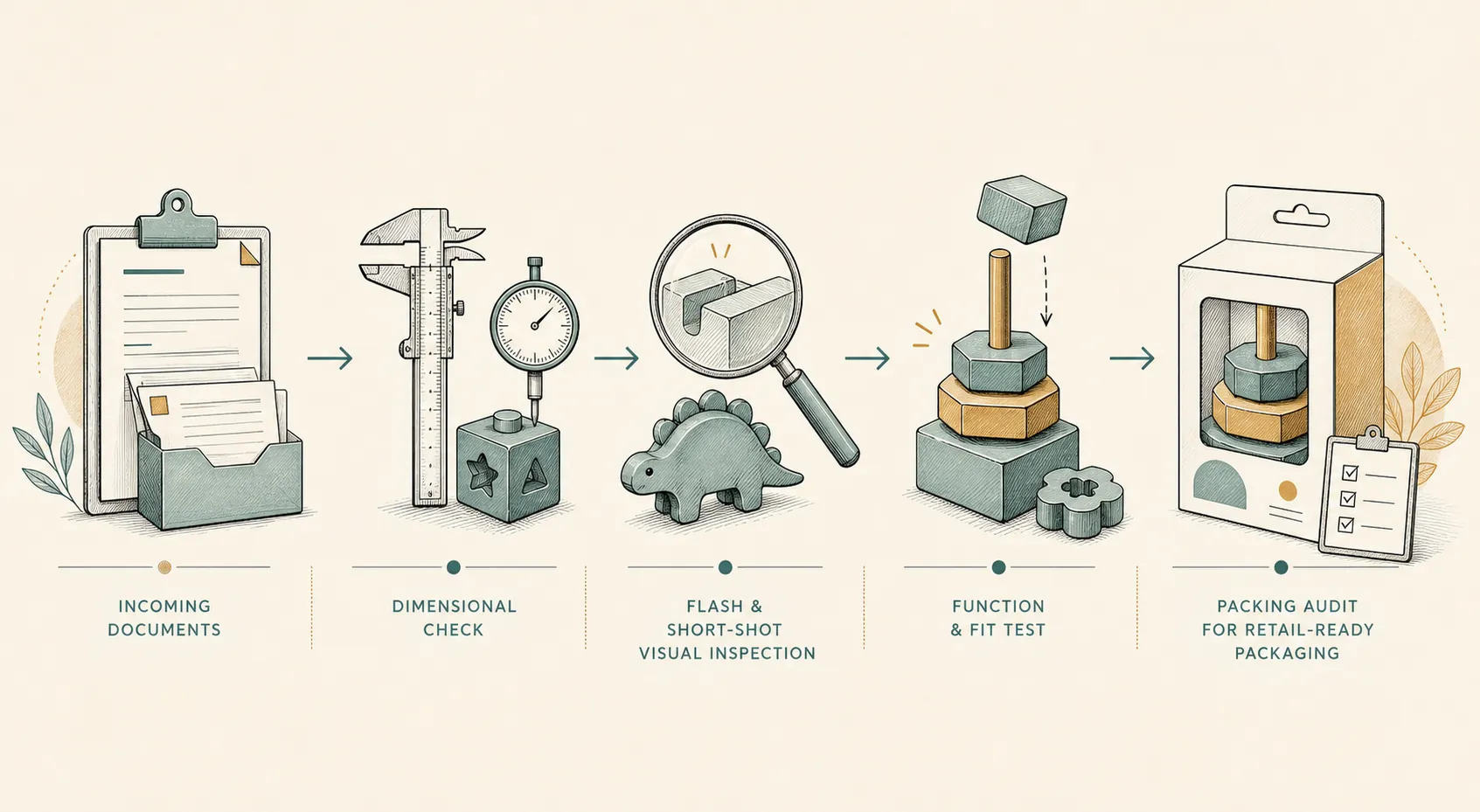
This guide walks procurement teams through a seven-step workflow: map candidate SKUs to your classroom activities, define your retail-ready packaging requirement, check MOQ and carton data against projected volume, review OEM packaging options, verify samples, confirm compliance documents per SKU, and then make a go/no-go decision. Every step includes the exact question to ask the supplier and a red flag to watch for.
Key Takeaways for Sourcing Fine Motor Toys Wholesale
- Match packaging to your distribution path: If you sell to schools through a catalog or web store, retail-ready packaging means individual product barcodes (EAN/UPC) that match the retailer or GS1 owner record, and cartons that can be split without losing product identity. If you supply classroom bins directly, bulk polybag packaging may be acceptable—but verify that the carton quantity aligns with your classroom count to avoid leftover inventory.
- MOQ is a program-fit question, not a price question: Before you negotiate price, compare the supplier's MOQ against your 12-month projected classroom need. A MOQ of 384 units for a dinosaur color-sorting fidget may be fine for a distributor but a poor fit for a single school district that needs 60 units per classroom set. Ask for mixed-carton options to test multiple SKUs at lower per-SKU volume.
- Samples are the only reliable packaging evidence: Request physical samples of 2–3 representative SKUs—one fine-motor, one sorting, one combined—and simulate handling: drop the carton, stack it, and check that the display carton opens without tearing. A type-test report or golden-sample photo does not prove that the production lot's packaging will survive transit.
- Compliance documents are per-SKU, not per-supplier: A supplier may have a CPSIA or ASTM F963 report for one product, but not for another in the same catalog. Ask for the document list per SKU, matching the SKU, materials, colors, and production date/cohort to your PO. A lab report from a golden sample does not automatically cover a later production lot.
How to Map Fine Motor and Sorting Toys to Your Classroom Program
Start with your program's needs, not the supplier's catalog. List the activities your classrooms require—buttoning, lacing, peg insertion, color sorting, shape matching, counting—and then match those to product types. For fine motor development, look for busy boards, activity cubes, and shape-matching games that require grasping, twisting, and placing. For sorting and categorization, look for counting animals, color sorting bowls, and stacking puzzles.
From the catalog records, a shortlist could include: the Montessori Busy Board (MOQ 240), the 6-in-1 Baby Activity Cubes (MOQ 80), the Shape Color Sorting Clock (MOQ 144, ABS), the Dinosaur Shape Matching Game (MOQ not stated, ABS), the Transport Counting & Color Sorting set (MOQ 24, plastic), the Elephant Activity Cube (MOQ 120, plastic/ABS), the Sorting Stacking Geometric Board (MOQ 48, plastic), the Quiet Book (MOQ 40, felt), the Sensory Counting Animals set (MOQ 60), the Dinosaur Color Sorting Fidget (MOQ 384, plastic), and the Color Sorting Counting Toy (MOQ 120, ABS). These MOQs range from 24 to 384 units, which is a wide spread—so your classroom volume directly determines which SKUs are worth pursuing.
Checkpoint: Does your shortlist include at least one SKU per activity type—fine-motor, sorting, and combined? If not, flag the gap and either adjust the program or ask the supplier for a similar product.
What Does Retail-Ready Packaging Mean for Fine Motor Toys?
Retail-ready packaging for fine motor toys goes beyond a printed box. For classroom and educational distribution, it means the product can go from the shipping carton to the display shelf or classroom bin without additional labor. Key elements: a display-ready outer carton that opens into a point-of-purchase display (or at least a carton that can be split into smaller units), an individual barcode on each unit that matches the retailer's or GS1 record, clear age grading and safety warnings on the label, and packaging that survives stacking and handling.
Ask the supplier to define their retail-ready standard for each SKU. Is the product individually polybagged, boxed, or in a display carton? What is the carton quantity and carton dimensions? Does the carton have a die-cut window or shelf tray, or does it require a separate display stand? If the supplier cannot articulate this, treat the packaging as not retail-ready and factor in repackaging cost.
For private-label programs, confirm which SKUs support OEM packaging changes—logo, hang tag, display box—and ask for the lead time for those changes versus stock packaging. A felt quiet book with a MOQ of 40 units may be easier to customize than a plastic injection-molded sorting set where the mold is already fixed.
How to Check MOQ and Carton Data Against Your Classroom Volume
For each shortlisted SKU, request the exact MOQ, carton quantity, and carton dimensions. Build a volume-fit matrix: SKU × MOQ × carton quantity × your 12-month classroom need. For example, if you need 60 units per classroom and have 10 classrooms, that is 600 units per year. A MOQ of 384 for the Dinosaur Color Sorting Fidget could cover one order, but a MOQ of 24 for the Transport Counting set might be too low to justify the freight cost per unit.
Ask for mixed-carton options. Many suppliers will allow a trial carton containing several SKUs, which lets you test the assortment without committing to full MOQs per line. Confirm the MOQ for mixed versus single-SKU cartons—this is often the difference between a viable trial order and a warehouse full of one slow-moving SKU.
Checkpoint: Does any SKU's MOQ exceed your 12-month projected need? If yes, flag it for negotiation, removal, or partnership with another buyer to share the volume.
How to Verify Packaging with Samples Before Bulk Commitment
Select 2–3 representative SKUs—one fine-motor (e.g., busy board), one sorting (e.g., counting animals), one combined (e.g., activity cube)—and request physical samples. Evaluate packaging durability: drop the carton from waist height, stack it under weight, and open it repeatedly. Check that the display carton does not tear at the perforation, that the barcode scans correctly, and that the label matches the product inside.
Production-part approval should compare the first released parts with the signed drawing, golden sample, and applicable safety test sample. Apply this to packaging: the sample you approve must match the production lot's packaging in material, print, and dimensions. If the supplier changes the resin grade, colorant, or packaging supplier without notice, the released toy may no longer match your approved sample.
Checkpoint: Did the sample packaging survive handling and display simulation? If not, request a packaging revision or drop the SKU. If the supplier cannot provide a packaging sample before bulk production, that is a red flag—ask for a written commitment to match the approved sample.
Which Compliance Documents Should You Confirm Per SKU?
Compliance documentation is per-SKU, not per-supplier. Ask the supplier which destination-market compliance documents are available for each shortlisted SKU—for the US market, typically CPSIA, ASTM F963, and possibly Prop 65. Do not assume coverage because the supplier has a generic certificate for one product.
A type-test or golden-sample report does not automatically cover a later production lot. Match the report's SKU, materials, colors, and production date/cohort to your PO. If the supplier cannot provide a current report for a specific SKU, mark it as conditional and require written confirmation before purchase—or ask for a third-party inspection on the production lot.
Also clarify who owns the test reports. Incoterms define when risk transfers between seller and buyer, but they do not define product-safety compliance or ownership of test reports. If the buyer needs the report for retail registration, ensure the supplier transfers the report or provides a letter of authorization.
What Is a Realistic Worked Example of a Sourcing Decision?
Worked example (illustrative, not a real shipment): A school supplier plans to offer a fine-motor/sorting assortment to 20 early-learning classrooms. They project 300 units of a sorting game and 200 units of a fine-motor board per year. They shortlist the Shape Color Sorting Clock (MOQ 144) and the Montessori Busy Board (MOQ 240). The supplier quotes MOQ and carton data: the clock ships 144 per carton, the busy board 240 per carton. The buyer's 12-month need for the clock (300) exceeds the MOQ, so it is viable. The busy board MOQ (240) exceeds the 200-unit need, so the buyer flags it—either negotiate a lower MOQ, share volume with another buyer, or drop it and test the Dinosaur Shape Matching Game (MOQ not stated) instead.
The buyer requests samples of the clock and the busy board. The clock sample arrives in a display carton that opens cleanly; the busy board sample arrives in a polybag with a hang tag, which would require repackaging for shelf display. The buyer asks for a boxed version and the supplier confirms an OEM packaging change with a 2-week lead time. The buyer also requests compliance docs: the clock has a current ASTM F963 report; the busy board has a CPSIA report from a different production batch. The buyer asks for the report matching the new production date. Based on the packaging evidence and MOQ fit, the buyer approves the clock and the busy board with the packaging change, and flags the quiet book (MOQ 40) as a trial item for the next order.
Packaging evidence, MOQ fit, and compliance confirmation combine into a go/no-go decision—not just a price comparison.
Supplier Evaluation Checklist for Fine Motor Toys Wholesale
| Packaging spec | What is the retail-ready packaging format per SKU (display carton, polybag, box)? Does the carton open into a shelf display? What are the carton dimensions and quantity? |
|---|---|
| MOQ fit | What is the exact MOQ per SKU, and does it fit your 12-month projected classroom need? Are mixed-carton options available, and what is the MOQ for mixed versus single-SKU cartons? |
| OEM packaging | Which SKUs support custom logo, hang tag, or display box? What is the lead time for OEM changes versus stock packaging? What are the design file requirements (e.g., AI, PDF, CMYK)? |
| Sample verification | Can the supplier provide a packaging sample before bulk production? What is the sample cost and turnaround? Does the sample match the signed drawing, golden sample, and safety test sample? |
| Compliance documents | Which destination-market documents (CPSIA, ASTM F963, Prop 65) are available per SKU? Are they current and do they match the SKU, materials, colors, and production date/cohort of your PO? |
| Quality inspection | Does the supplier offer a third-party inspection option (e.g., AQL sampling per ISO 2859-1)? What are the inspection levels and AQL values for critical, major, and minor defects? Ask for the inspection report to be shared before shipment. |
Red Flags to Watch for When Sourcing Fine Motor Toys
A supplier who cannot define their retail-ready packaging standard for each SKU is a red flag—it means you will likely face repackaging costs or shelf-display failures. A supplier who offers a generic compliance certificate without matching it to your SKU and production batch is another red flag; a type-test report does not cover a later lot. And a supplier who changes resin grade, colorant, or packaging without notice violates the expectation that the released toy should match the approved sample.
Also watch for barcode mismatches: EAN/UPC symbols are formats, but the data assignment must match the retailer or GS1 owner record. If the supplier prints a barcode that does not correspond to your retail account, the product will not scan at checkout. Confirm the barcode ownership before bulk production.
Finally, do not assume that a low MOQ means a low-risk trial. A MOQ of 24 units for a plastic sorting set may be attractive, but if the carton quantity is 24 and you need 600 units, you will pay freight on 25 cartons—so the per-unit landed cost may be higher than a SKU with a higher MOQ but better carton economics.
How to Build a Sourcing Brief Template for Your Supplier
A useful toy RFQ states destination market, age grade, materials and colors, packaging language, requested tests, sample policy, tooling terms, and the requested trade term. For fine motor toys wholesale with retail-ready packaging, add the following questions to your sourcing brief:
For each shortlisted SKU: What is the exact MOQ, carton quantity, and carton dimensions? Which SKUs are available in retail-ready packaging as standard, and which require an OEM/custom packaging order? What is the lead time for OEM packaging changes (logo, hang tag, display box) versus stock packaging? Can you provide a packaging sample before bulk production, and what is the sample cost and turnaround? Which destination-market compliance documents (CPSIA, ASTM F963, Prop 65) are available per SKU, and are they current? Are there mixed-carton options for trial orders across fine-motor and sorting SKUs, and what is the MOQ for mixed versus single-SKU cartons?
Send this brief as a written document, not just an email. It creates a paper trail that you can use to compare suppliers objectively and to hold the chosen supplier accountable for the stated packaging and compliance commitments.
FAQ: Fine Motor Toys Wholesale and Retail-Ready Packaging
What MOQ should I expect for fine motor toys wholesale from a Chinese supplier?
MOQs vary by product type and packaging. For the catalog, MOQs range from 24 units (Transport Counting set) to 384 units (Dinosaur Color Sorting Fidget). Ask for the exact MOQ per SKU and compare it against your 12-month classroom need. Mixed-carton options may lower the per-SKU commitment.
What is the typical lead time for bulk educational toy orders from Asia to a US distribution center?
Lead times depend on production, packaging, and shipping method. For stock items, production may take 2–4 weeks; OEM packaging changes add lead time. Ocean freight from China to the US West Coast typically takes 15–25 days. Confirm the lead time in writing before placing the order.
Can suppliers offer custom packaging for retail-ready fine motor toys?
Yes, many suppliers offer OEM packaging, but not for every SKU. Ask which SKUs support logo, hang tag, or display box changes, and request the lead time and design file requirements (e.g., AI, PDF, CMYK). For injection-molded products, the mold may be fixed, limiting packaging customization.
What compliance documents should I request for fine motor toys sold in the US?
Common documents include CPSIA, ASTM F963, and possibly Prop 65 for California. Ask for the report per SKU, and verify it matches the SKU, materials, colors, and production date/cohort of your PO. A type-test report from a golden sample does not automatically cover a later production lot.
How do I verify packaging quality before placing a bulk order?
Request physical samples of 2–3 representative SKUs and simulate handling: drop the carton, stack it, and open it repeatedly. Check that the display carton opens cleanly and the barcode scans correctly. Compare the sample to the signed drawing and golden sample, and ask for a third-party inspection on the production lot.
What is the risk of a supplier changing packaging without notice?
A change in resin grade, colorant, packaging material, or sub-supplier can affect the released toy and its compliance. Ask the supplier to commit to a change-notice process in writing. If they change packaging without approval, the product may not match your approved sample or safety test.
Sources
- toys plan keep your child safe
- AQL标准,验货公司,抽检验货服务 验货公司,检品公司 验货 监装 验厂(发布时间:2024-01-05 16:52:00)
Related Products & Categories
Request a Quote for Fine Motor Toys Wholesale
Ready to evaluate fine motor and sorting toys for your early learning classrooms? Use the sourcing brief template above to request quotes from suppliers, and ask for MOQ, carton data, packaging samples, and compliance documents per SKU. For a starting point, you can review the Early Learning & Language Toys collection and the Fine-Motor Focus Fidgets collection to see product types that fit classroom programs. Submit your RFQ with your destination market and classroom volume, and compare supplier responses against the checklist.