
Esjay Recall: Which Fine-Motor Toy Samples Proceed?
Esjay recall: review fine-motor toy samples for classroom use, compare mechanisms, separate observation from testing, and assign HOLD for open points.
For Kidumio's school-supply and educational-distribution review, use the Esjay mechanism only to decide whether a question transfers to a selected sample. Mark the comparison COMPARABLE when the SKU has a comparable play mechanism and component, so the Esjay-based question can be asked. Mark it NOT COMPARABLE when the SKU clearly lacks that mechanism or component; record the Esjay question as not applicable and continue the SKU's own review. Mark it UNKNOWN, and keep the review on HOLD, when the mechanism, component, written specification, or required qualified evidence remains unresolved. The September 17, 2026 U.S. CPSC notice is evidence about Esjay Toddler Busy Board Montessori Toys—not about unrelated products. It reports detachable red knobs on a product intended for children under three. This brief turns that mechanism into a disciplined sample comparison for classroom purchasing, without treating hand inspection as safety testing. CPSC recall notice
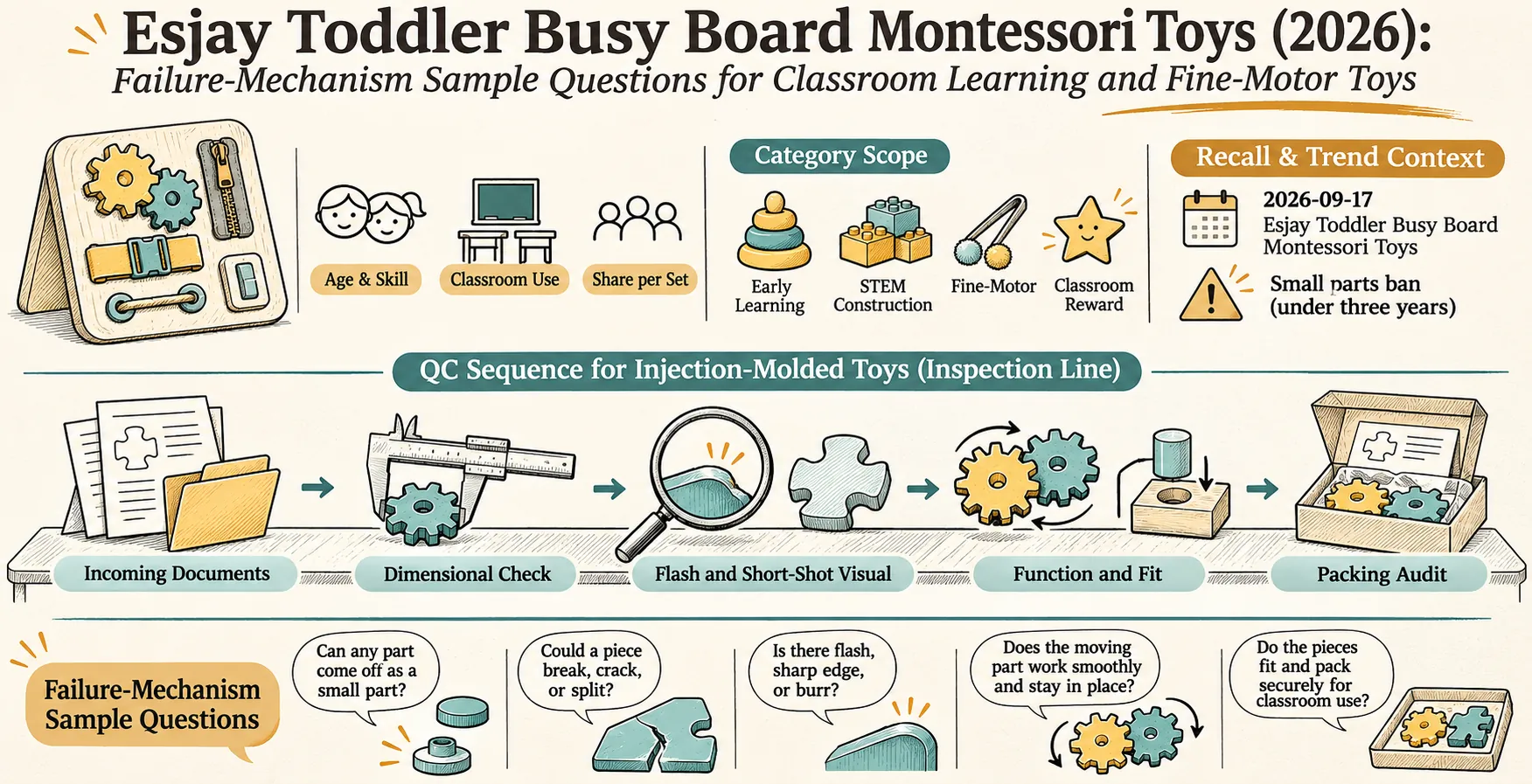
What does the dated Esjay notice establish, and what does it not establish?
The notice establishes a product-specific U.S. hazard finding: the recalled Esjay toy was intended for children under three, and its red knobs could detach, creating a deadly choking hazard under the small parts ban. The notice is dated September 17, 2026, and applies to the named Esjay product. CPSC recall notice
The recalled design is described as a five-page blue felt busy board, with the red-knob component on the second page. That configuration is the comparison trigger; it is not a reason to classify every busy board, busy cube, Montessori-labeled toy, or ABS product as having the same failure mechanism.
This is external evidence used in a Kidumio editorial sourcing brief. The notice does not establish that CPS287898, CPS286358, Kidumio, a Kidumio supplier, or any unrelated product is recalled, unsafe, or implicated. Transfer the question only after checking whether the selected sample actually has a comparable mechanism and component; if it is confirmed not comparable, record the Esjay question as not applicable rather than treating the candidate as recalled or unsafe.
Does each candidate match the recalled mechanism and component?
The mechanism match is unresolved for both catalog candidates until the physical sample is compared with the written design. Catalog wording can identify a product family, but it cannot prove that a red-knob page is present or absent.
| Field | Details |
|---|---|
| CPS287898 | The catalog identifies an ABS baby busy cube with colour-box packaging. The red-knob/page component is not identified in the catalog copy. Confirm the physical mechanism and component before transferring the Esjay-based question. |
| CPS286358 | The catalog identifies an ABS travel busy cube with single-item packaging. The red-knob/page component is not identified in the catalog copy. Confirm the physical mechanism and component before transferring the Esjay-based question. |
| Red-knob/page component | Not identified in the supplied catalog copy for either candidate. This is a documentation limitation, not proof that the component is physically absent. |
| Comparison boundary | Treat both SKUs as comparison candidates only. The external Esjay notice does not implicate either candidate or any related supplier. |
Which checks can a buyer observe at sample review?
A buyer can compare the physical sample with the agreed written specification and design requirements, then record visible condition, operation, dimensions, materials, finish, and packaging. These observations describe the sample; they do not establish regulatory safety or a safe age.
Use the inspection sequence below. Record the target before recording the observation, so a clean-looking sample is not mistaken for an approved sample.
| Field | Details |
|---|---|
| 1. Identity and revision | Compare the selected SKU or model, sample reference, catalog snapshot dated October 9, 2026, written specification, and design revision. A label or sample mismatch is a failure of review identity; stop the comparison and resolve the correct reference. |
| 2. Mechanism and component | Compare the sample's actual play mechanism with the recalled five-page busy-board mechanism and check whether a comparable red-knob/page component is present, loose, damaged, or not verified. Unexpected movement, detachment, or a design mismatch means HOLD pending clarification and qualified review. |
| 3. Function | Operate each stated activity as designed and record whether the intended movement works, whether parts interfere with one another, and whether any component shifts during ordinary handling. Do not turn this handling observation into a pass or compliance result. |
| 4. Materials and construction | Compare the agreed material and construction description with the sample. A catalog entry such as ABS may describe a casing or component; it does not establish that the entire toy has the same construction or touch characteristics. |
| 5. Finish | Record visible burrs, sharp-looking edges, rough seams, cracking, loose trim, incomplete stitching, damaged surfaces, or unclear markings. Escalate a defect against the written acceptance requirement rather than assigning a regulatory conclusion. |
| 6. Dimensions | Measure the sample against the agreed target dimensions and record the actual observation. Use the written specification for any tolerance; do not invent a tolerance from the catalog listing. |
| 7. Packaging and labeling | Compare the agreed pack type, item count, model identity, instructions, warnings, and package markings. Packaging agreement supports traceability but does not prove toy safety or classroom suitability. |
Which conclusions require qualified testing rather than hand inspection?
A qualified laboratory or other competent testing process is required for a safety conclusion about small parts, attachment integrity, or applicable compliance requirements. A buyer's visual check or hand check can document condition and apparent movement, but it cannot certify safety or determine age.
Request evidence tied to the exact SKU, model revision, construction, and destination market. The record should identify the tested configuration, evaluation scope, date, result, and any conditions or limitations. Do not invent a pulling force, cycle count, tolerance, or test standard, and do not substitute an improvised pull for the applicable laboratory test.
Age and classroom questions also require separate treatment. A stated age range is a product claim to verify for the exact model; it is not established by the presence or absence of a knob, a catalog photograph, or an adult's hand check.
| Field | Details |
|---|---|
| Small-parts conclusion | Use qualified evidence for the applicable destination-market requirement and exact toy configuration. A visible component review is only an observation. |
| Attachment conclusion | Use qualified assessment for whether a relevant component remains attached under the applicable test conditions. Do not publish a safety conclusion from an improvised hand pull. |
| Age statement | Record the stated age and skill use for the exact model and revision, then keep that statement separate from the buyer's physical observations. |
| Compliance decision | Require the appropriate qualified documentation before closing the safety-related review. If the scope, model, or result does not match the sample, keep the decision unresolved. |
What should buyers ask about age, skill, classroom use, and sharing?
For fine motor skills toys, ask item-specific questions before transferring a product from sample review to classroom purchasing. The answers should describe the exact model and revision, not a broader product family or a marketing label.
| Field | Details |
|---|---|
| Age and skill | What age range is stated for this exact model and revision? Which fine-motor actions or learning skills is the product designed to support? Which physical activity demonstrates each stated skill? Are any removable or attached components part of that activity? |
| Classroom use | Is the intended use individual play, teacher-led demonstration, supervised rotation, or another stated condition? Which activities require one child at a time? What storage, cleaning, supervision, or handling conditions should the buyer record for classroom use? |
| Sharing capacity | How many children can use one set at the same time under the stated classroom conditions? What is the supply unit: one physical toy, a multi-piece set, or several individually packaged units? Record the physical count only after the sample packaging and written specification agree. |
| Mechanism transfer | Does this sample contain the same type of page, knob, attachment point, or other component that triggered the Esjay question? If not, which failure mechanism is actually relevant to this SKU? Do not transfer the red-knob question solely because both products are described as Montessori or busy-board toys. |
What should the sample approval record contain?
A usable approval record connects the sample to its identity, target specification, observation, decision, approver, and follow-up. The retained sample supports that record, but it does not replace the written specification or change history.
| Field | Details |
|---|---|
| Identity and revision | Record the selected SKU or model, sample reference, catalog snapshot date, written specification revision, design revision, and review date. |
| Target versus observation | For each function, material, finish, dimension, component, and packaging requirement, write the agreed target first and the physical observation second. |
| Failure signal | Describe the observable signal precisely: mechanism mismatch, unexpected looseness, visible damage, detachment, dimension variance against the agreed target, packaging mismatch, or unresolved component identity. |
| Evidence status | Separate visual and handling observations from qualified test evidence. Record the applicable request, document scope, model match, result, and conditions when a safety conclusion is required. |
| Decision and conditions | Use APPROVE only for the defined sample stage when the comparison is resolved and conditions are recorded. Use HOLD when the mechanism match, component identity, required evidence, or specification revision remains unresolved. |
| Responsible approval | Record the responsible approver's name or role, approval date, decision conditions, and any restrictions on transferring the result to production. |
| Follow-up closure | Assign an owner and due date for correction, re-sample, document review, or qualified testing. Close the item only with a traceable follow-up reference. |
When should the buyer mark the sample review HOLD?
Mark the review HOLD when the selected SKU cannot yet be matched to the relevant mechanism and component, when the physical sample conflicts with the written specification, or when a required qualified review has not been completed. HOLD means the purchasing decision is unresolved; it does not mean that the product has been proven unsafe.
A missing photograph alone does not invalidate the review. Record the available identity, specification, observation, and evidence status, then request the physical or documentary confirmation needed for the open point. Do not approve because a catalog image does not show a red knob, and do not reject a candidate solely because the external Esjay notice names a different product.
After sample approval, create and retain the approved production reference. Bulk inspection is the next stage: compare production against the written specification, the approved reference, and applicable change records. The retained sample is a useful control, but it is not the only valid basis for bulk inspection.
What should buyers clarify before closing this review?
Does the Esjay recall automatically put CPS287898 or CPS286358 on hold?
No. The notice is product-specific and does not implicate those candidates. Place a candidate on HOLD only when its own mechanism comparison, specification review, or required evidence remains unresolved.
Can a quick visual check or hand pull clear the small-parts issue?
No. It can document visible condition or apparent movement, but it cannot certify safety, determine age, or replace the applicable qualified laboratory assessment.
Does the absence of a red knob in catalog wording prove the component is absent?
No. For both catalog candidates, the red-knob/page component is not identified in the supplied copy. Physical presence or absence must be checked against the sample and written construction record.