
Educational Toys Wholesale in Late 2026: Why Tactile Problem-Solving Beats Talking AI Gadgets
Late-2026 educational toys wholesale guide: NAEYC/AAP evidence, Cozy Culture trend data, CPSC small-parts fields and a $108 vs $840 classroom cost model.
Picture the classroom corner in a Title I pre-K room in November 2026: one shelf holds a 12-piece wooden puzzle tray, a snap-block bin and a sorting tray; the next shelf holds a talking AI companion that answers a 4-year-old's question in a synthesized voice. The curriculum buyer writing the January purchase order has to decide which shelf gets 6 more units and which gets 1. That decision is the core of educational toys wholesale planning for late 2026, and the evidence favors the tactile shelf.
The buyer's first three fields are age and skill, classroom use, and how many kids can share a set. states good toys for young children must match their stages of development and emerging abilities, and for 2-year-olds it names wood puzzles with 4 to 12 pieces, snap-together blocks and sorting objects as problem-solving toys. A talking AI gadget answers one child at a time; a 4-child tactile set seats 4 children around one tray and turns a $18 unit into a $4.50 per-seat classroom asset in the illustrative model below.
This guide is written for school suppliers, classroom wholesalers and educational distributors buying by the carton. It maps , AAP, and evidence to SKU fields, translates the Toy Association's Cozy Culture trend and Circana's 2025 category dollars into carton-mix decisions, and lists the CPSC small-parts, choking-label and CPC citation fields that gate every SKU before it reaches a mixed-age classroom.
Stage-matched, open-ended toys are the developmental default
The American Academy of Pediatrics report guidance is blunt: the best toys match a child's developmental skills and encourage the development of new skills, and digital toys should never take the place of real, face-to-face play. The same guidance names blocks, shapes, puzzles and trains as traditional favorites that build problem solving and fine motor skills, and it warns that most tablets, computer games and apps advertised as educational target memory skills such as ABCs and shapes, while impulse control, managing emotions and creative, flexible thinking are best learned through unstructured and social play.
block-play article gives the buyer a ready-made skill list for shelf talk and teacher notes: problem solving, mathematics (length, measurement, comparison, number, estimation, symmetry, balance), turn-taking and sharing, attention span, and fine and gross motor development. That is 5 named outcome clusters a school supplier can print on a product card without inventing a claim, and each one maps to a physical action a teacher can observe in a 20-minute center rotation.
Center on the Developing Child adds the mechanism: through games and playful activities, children practice and strengthen executive function skills including focusing attention, working memory and basic self-control, with handouts organized by age from 6 months to 13-17 years. states a child's brain develops more in the first three years of life than at any other time, and that stacking objects builds sensory-motor skills and spatial understanding while hide-and-find games practice concentration, problem solving and flexible thinking. For a buyer, the practical translation is a 3-field spec sheet: age band, named skill, and the physical action that demonstrates it.
Executive function and turn-taking: what hands-on manipulation actually practices
Executive function is not a marketing adjective in this literature; it is a named set of three skills. lists focusing attention, working memory and basic self-control as the executive function skills children practice through games and playful activities, and it notes that activities for younger children are designed for adults to engage in with children, while activities for later ages let adults step back so children play more often with peers. A tactile set with 4 seats and one shared tray forces the turn-taking sequence that a single-user gadget removes.
play framework ties this to three core principles: supporting responsive relationships, strengthening core life skills and reducing sources of stress. A classroom corner with a 4-child puzzle rotation practices all three in one 20-minute block, because the adult models a move, the child repeats it, and the group negotiates whose turn is next. makes the same point from the home side: children do not need expensive toys to play and learn, and everyday materials can create engaging games, which is why a $18 open-ended set holds its value against a $35 single-purpose device.
The buyer-facing output is a teacher note with 3 lines: the age band, the executive function skill practiced, and the turn-taking rule. A 4-seat set with a 4-step turn card documents attention, working memory and self-control in one page, and that page is what a school supplier hands to a curriculum committee that has already read the AAP warning about app-based 'educational' labels.
Late-2026 market signals: Cozy Culture, Games/Puzzles and the carton mix
The Toy Association's 2026 trends name Cozy Culture: as digital life speeds up, families are choosing low-tech and no-tech toys with tactile materials and gentle interactivity to counter constant digital stimulation, with play framed as a screen-free space for emotional regulation, creativity and connection. That is a direct demand signal for bulk sensory toys, bulk fidget toys and tactile puzzle assortments, and it sits alongside the association's finding that 78% of parents want more toys that help their kids develop skills such as creativity and problem solving.
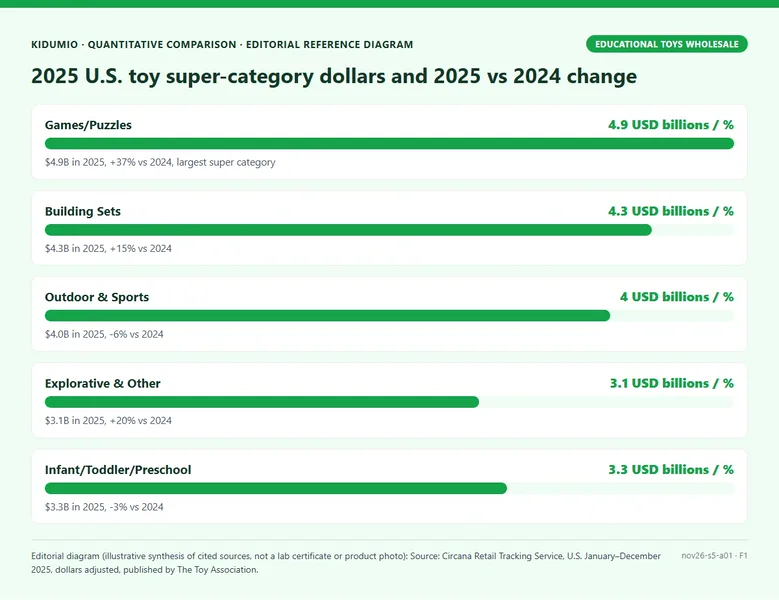
The dollar data sharpens the reorder decision. Circana data published by The Toy Association show Games/Puzzles at $4.9 billion in 2025, up 37% vs 2024 and the largest super category, while Building Sets reached $4.3 billion (+15%), Explorative & Other Toys reached $3.1 billion (+20%), and Outdoor & Sports Toys fell to $4.0 billion (-6%). Total U.S. retail toy sales were $30.3 billion in 2025, up 6% vs 2024, across a Circana panel covering 68% of the market.
A carton mix for a late-2026 reorder can weight the growing categories without abandoning the flat ones. If a distributor's 10-carton reorder previously split 4 cartons Games/Puzzles, 3 Building Sets, 2 Infant/Toddler/Preschool and 1 Outdoor, a trend-weighted split of 5 Games/Puzzles, 3 Building Sets, 1 Explorative and 1 Infant/Toddler/Preschool moves 1 carton from the -6% Outdoor category into the +37% Games/Puzzles category and the +20% Explorative category. The STEM signal supports the building side: the Toy Association reports the global STEM toys segment is predicted to nearly double between 2024 and 2034, per market.us.
Tactile problem-solving set vs talking AI gadget: buyer decision table
The table compares the two SKU types on the 5 fields a classroom buyer writes into an approval worksheet: age and stage fit, share count, named skills, compliance fields and per-classroom cost. Cost figures come from the illustrative planning example below, not from a quotation.
| Criterion | Talking AI gadget | Tactile problem-solving set |
|---|---|---|
| Age and stage fit | Single-purpose script; AAP warns app-based 'educational' labels target memory skills only | Matches stage guidance; open-ended, 4 to 12 puzzle pieces for 2-year-olds |
| Share count | 1 user per device; 24 devices for 24 children | 4 children per set in the illustrative model |
| Named skills | Variable; substitutes for face-to-face interaction per AAP guidance | Problem solving, math, turn-taking, attention span, fine and gross motor |
| Compliance fields | Same CPSC fields plus electronics and power checks | Small-parts status under 16 C.F.R. part 1501, choking label under § 1500.19, CPC citation '16 CFR part 1501 – Small parts' |
| Per-classroom cost (24 children) | $840: 24 units × $35 | $108: 6 sets × $18 |
Illustrative classroom cost model: $108 vs $840
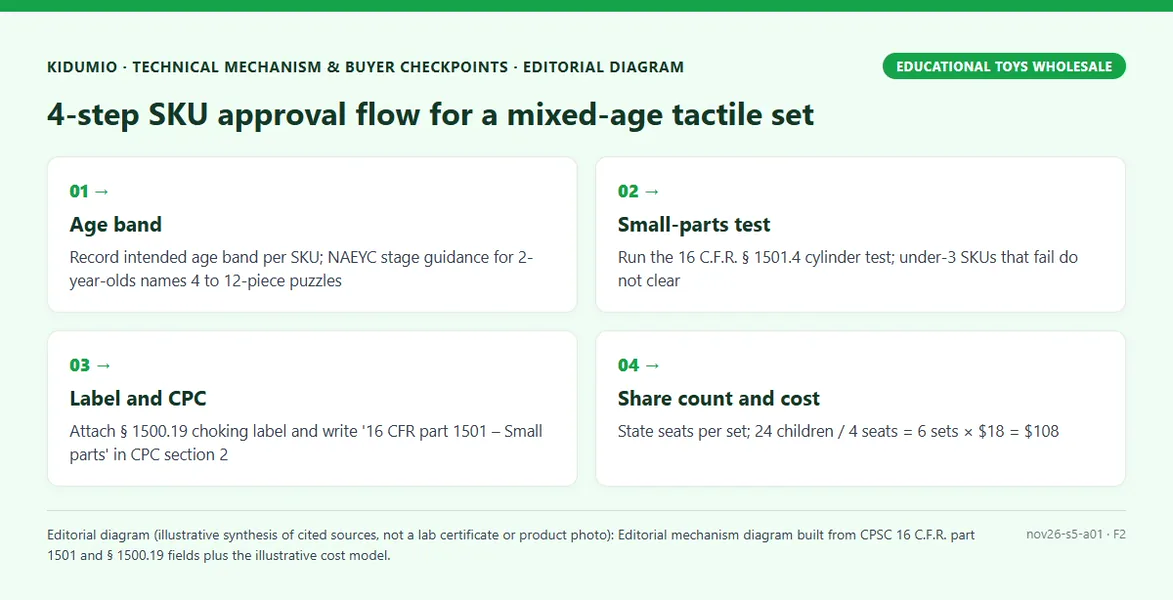
This is an illustrative planning calculation, not a lab test and not a price quote. Inputs: a 24-child classroom, a tactile set at $18 with 4 children per set, and a talking AI gadget at $35 with 1 user per device. Tactile: 24 / 4 = 6 sets, and 6 × $18 = $108. AI: 24 × $35 = $840. Difference: $840 − $108 = $732, which is about 87% lower for the shared tactile model.
The same arithmetic scales to a 10-classroom building: 10 × $108 = $1,080 for shared tactile sets versus 10 × $840 = $8,400 for one-per-child AI gadgets, a $7,320 gap. A buyer can run the model with any 3 inputs (class size, children per set, unit price) and get a per-seat figure; at $18 and 4 seats, the per-seat cost is $4.50, and at $35 and 1 seat, the per-seat cost is $35.
The compliance gate: small-parts status, choking label and CPC citation
CPSC bans children's products intended for use by children under 3 that present a choking, aspiration or ingestion hazard because of small parts, codified at 16 C.F.R. part 1501. A small part is any object that fits, without compressing and in any orientation, entirely into the small parts cylinder at 16 C.F.R. § 1501.4, which approximates the fully expanded throat of a child under 3. A whole toy, a separate part, or a piece that breaks off during use-and-abuse testing all count.
Two more fields gate the SKU. CPSC requires choking-hazard warning labels on certain children's products that are or contain small parts, balloons, small balls or marbles under 16 C.F.R. § 1500.19, and advertising for those toys must carry the same warning under 16 C.F.R. § 1500.20. For the small parts ban, the citation to use in section 2 of the Children's Product Certificate is "16 CFR part 1501 – Small parts", and the choking-hazard warning label requirement does not need to be included in a CPC.
A mixed-age classroom set creates the hardest case: a 4-piece puzzle for a 2-year-old and a 40-piece puzzle for a 5-year-old cannot share one small-parts status. The approval worksheet needs one row per SKU with 4 fields: intended age band, small-parts cylinder result, choking-label text and CPC citation. A SKU intended for under-3 use that fails the cylinder test does not clear the worksheet, and a SKU labeled for 3+ needs the § 1500.19 warning on the retail carton and in the ad copy.
Sample review and quotation checklist for carton buyers
A sample review separates an open-ended tactile toy from a closed, single-answer gadget in 4 questions. First, does the set have more than one valid end state, such as a block tower that can be rebuilt in 3 different structures? Second, how many children can use it at once, and does the carton state that share count? Third, which outcome does the teacher note name, and is it one of the 5 clusters (problem solving, math, turn-taking, attention span, motor)? Fourth, does the CPC citation match the SKU's intended age band?
The quotation side has its own fields. Kidumio's site profile lists a 300-piece minimum order quantity, a 25-35 day lead time, 200+ staff, 8,000 pcs monthly capacity, 15 production lines, EN71 certification and exports to 30+ countries. A 300-piece MOQ at 4 children per set equips 1,200 classroom seats in one order, and at a 25-35 day lead time a January purchase order placed in the first week of November lands before a mid-December classroom refresh.
The catalog positioning covers sensory learning toys, puzzle play products, tactile fidgets and classroom reward items for North American distributors, school suppliers and institutional buyers, with MOQ guidance, carton data, OEM packaging options and destination-market compliance document coordination. A buyer can use the 300-piece MOQ to build a mixed carton: 100 puzzle trays, 100 snap-block sets and 100 tactile fidgets, then split the carton across 3 classroom age bands.
Are tactile problem-solving toys better than talking AI gadgets for classrooms?
Tactile problem-solving toys are the better core classroom inventory because and AAP evidence favors stage-matched, open-ended toys that build problem solving, fine motor skills and face-to-face play. AAP guidance states digital toys should never take the place of real, face-to-face play, and names blocks, shapes, puzzles and trains as traditional favorites that build problem solving and fine motor skills. A talking AI gadget fits as a supplementary single-user SKU, not as the default shelf.
How many children can share one tactile set, and what does that do to per-child cost?
One tactile set can seat 4 children in the illustrative model, which equips a 24-child classroom with 6 sets for $108 at an $18 unit price, or $4.50 per seat. A single-user talking AI gadget at $35 per device costs $840 for the same 24 children, or $35 per seat. The share count is a SKU field, so the carton data and the teacher note must both state the number of seats.
What compliance fields must I check before ordering a tactile set?
Confirm 3 CPSC fields per SKU: small-parts status under 16 C.F.R. part 1501, choking-hazard warning labeling under 16 C.F.R. § 1500.19, and the CPC citation "16 CFR part 1501 – Small parts" in section 2 of the Children's Product Certificate. A SKU intended for children under 3 that fails the small parts cylinder at 16 C.F.R. § 1501.4 does not clear the approval worksheet. The choking-hazard warning label requirement does not need to be included in the CPC.
Build the late-2026 tactile carton mix
Kidumio's catalog desk supports school suppliers and educational distributors with sensory learning toys, puzzle play products, tactile fidgets and classroom reward items, plus MOQ guidance, carton data, OEM packaging options and destination-market compliance document coordination. Start with a 300-piece mixed carton, request the sample review against the 4 open-endedness questions, and map each SKU to its age band, share count and CPC citation before the January purchase order closes.
Sources
www.cpsc.gov — Small Parts Ban and Choking Hazard Labeling | CPSC.gov