
Educational Toys by Age Wholesale: Write Display Notes That Prove Learning Value
Wholesale guide to age-band classroom planning: align learning goals with safety standards (ASTM, EN71) and write display notes that sell.
If your buyers must justify every purchase with a learning outcome, plan your assortment by age band and back it with display notes; if they only need price and safety proof, a simple category catalog will do. The difference is in the display notes — the one-page explanation that connects a toy's age range to the skill it builds and the standard it meets.
This guide is for school suppliers, educational distributors, classroom buyers, and institutional purchasing teams building preschool-through-primary assortments. You will get a decision framework for age-band planning, a checklist of what to verify in supplier evidence, and a display-note structure your retail customers can quote to their own committees.
What Does Age-Band Classroom Planning Actually Mean for Wholesale Buyers?
Age-band classroom planning means grouping toys by the developmental stage they serve — infants, toddlers, preschoolers, early elementary — and selecting products whose learning task matches that stage. It is a merchandising and procurement strategy, not a child-development claim. The age label on a toy reflects safety testing parameters first, not intelligence or maturity.
For a wholesale buyer, the practical consequence is that age bands align with regulatory testing thresholds. In the United States, the CPSC defines a toy as any object designed, manufactured, or marketed as a plaything for children under 14, and ASTM F963 is the mandatory consumer product safety standard under the Consumer Product Safety Improvement Act (CPSIA), codified at 16 C.F.R. part 1250. Third-party testing and a Children's Product Certificate (CPC) are required for toys intended primarily for children 12 and under.
The learning-and-development layer is what you add on top of that regulatory floor: a display note that says which skill the toy exercises and why that skill matters at that age. The core claim is simple — a learning and development decision for age-band classroom planning should be based on comparable product and supplier evidence, not on marketing copy.
Key Takeaways
- Safety proof is the gate: Verify ASTM F963 and a Children's Product Certificate (CPC) for toys intended for children 12 and under in the US market; EN71 is the parallel EU standard. A batch-specific test report, not a generic certificate, is the evidence you need.
- Age labels are safety-based: Age grading reflects choking, small-parts, edge, and cord hazards — not a child's intelligence. Display notes should state the safety rationale, not promise developmental outcomes.
- Small parts rule the under-3 band: The small-parts ban applies to toys for children under 3, with labeling per 16 C.F.R. § 1500.19(b)(1). Building blocks and construction sets need piece-size and connection-force controls; a large box does not make every piece safe for every age.
- Test reports are batch-specific: A test report is valid only for the specific production lot. Material or design changes require retesting — ask your supplier how they handle revisions.
- Display notes are a buyer action: The next step after selecting an age band is writing a display note that pairs the toy with its learning task, its safety standard, and the verification evidence — so your customers can reorder with confidence.
Which Safety Standards Should You Verify Before Placing a Wholesale Order?
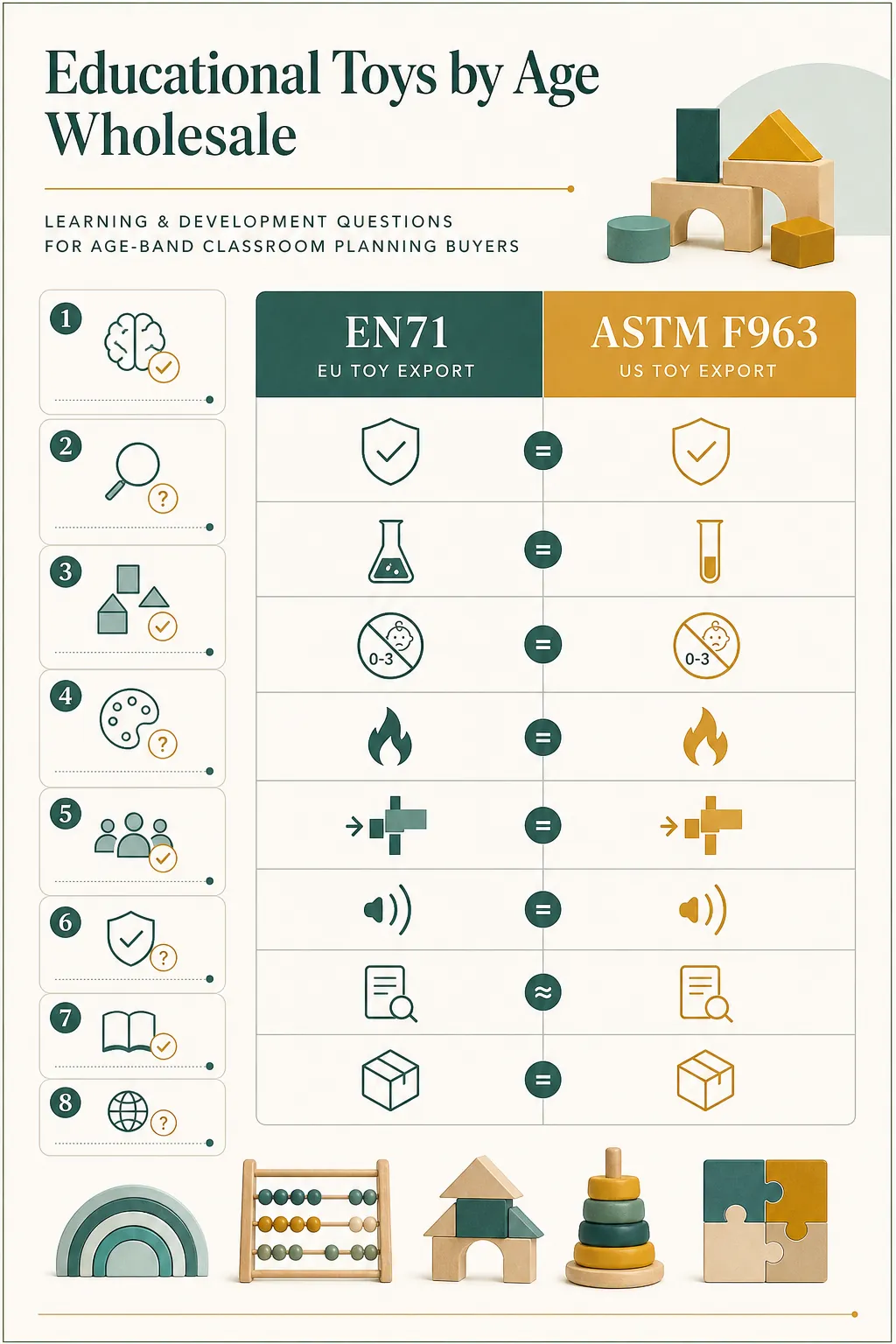
Verify the standard that applies to your destination market, then confirm the supplier's test report covers the current version of that standard. For the US, that is ASTM F963-23, the latest version of the Standard Consumer Safety Specification for Toy Safety, which became effective April 20, 2024. For the EU, the parallel requirement is EN 71.
ASTM F963 covers mechanical hazards (sharp edges, small parts), flammability, chemical limits (lead, heavy metals, phthalates), magnet ingestion, sound-producing toys, and battery accessibility. The CPSC notes that some sections of ASTM F963 restate existing CPSC or FDA regulations and are therefore not separately mandatory, so a supplier's test report should map to the specific sections that apply to the toy type.
For chemistry, CPSC guidance notes individual solubility limits for antimony, arsenic, barium, cadmium, chromium, mercury, and selenium in the applicable toy chemistry assessment. These are the figures a buyer should see reflected in a test report, not just a certificate name.
A squishy toy made of PU foam, a battery-operated flash card reader, and a 300-piece magnetic building set each trigger different sections of the standard. Confirm which sections apply before you compare quotes.
Standards by Market: What Buyers Should Verify
| US — ASTM F963 | Mandatory consumer product safety standard for toys under CPSIA, codified at 16 C.F.R. part 1250. Current version F963-23 effective April 20, 2024. Proof: batch-specific test report from a CPSC-accepted lab plus a Children's Product Certificate (CPC). |
|---|---|
| US — Small parts | Ban applies to toys for children under 3, with labeling per 16 C.F.R. § 1500.19(b)(1). Use-and-abuse test methods in 16 CFR 1500.50–53 cover impact, bite, flex, torque, and tension. |
| EU — EN 71 | Parallel safety standard for toys sold in the EU. Proof: EN71 test report from the supplier. Verify it covers the current edition. |
| CE marking | Required for many toys sold in the EEA; indicates conformity with applicable EU directives. Proof: Declaration of Conformity and technical file. |
| CPC (Children's Product Certificate) | Required for toys intended primarily for children 12 and under in the US. Must accompany shipments and be available to distributors, retailers, and CPSC upon request. Proof: signed CPC citing the specific ASTM F963 sections tested. |
How Do Learning Goals Map to Age Bands for Display Notes?
Display notes connect three things: the age band, the safety rationale, and the learning task. The safety rationale comes from the standard; the learning task comes from the toy type. You do not need a child-development study to write a defensible note — you need the toy's mechanism and the age-appropriate skill it exercises.
For infants and toddlers (under 3), the priority is sensory exploration and motor control, with an absolute constraint: no small parts. Large, soft, non-toxic toys are the safe choice. A display note might read: 'Large-format sensory toy; exercises grasp and visual tracking; meets small-parts requirements for under-3.'
For preschoolers (3–5), the priority shifts to construction, sorting, and role-play. Blocks, shape sorters, and puzzles fit here. The safety constraint is sharp edges and points — toys for children under 8 must not have hazardous edges, points, or puncture hazards before and after use-and-abuse testing. A display note might read: 'Construction set; develops spatial reasoning and fine motor control; edge-tested for under-8.'
For early elementary (6–8), the priority moves to rules-based play, STEM concepts, and collaborative tasks. Magnetic building sets and flash card readers fit here. The safety constraint broadens: magnet ingestion is a specific hazard category in ASTM F963, and battery-operated toys must prevent access to batteries during play. A display note might read: 'Magnetic building set; introduces geometric relationships and collaborative problem-solving; magnet-safety tested per ASTM F963.'
Avoid sensory overload in any band. Toys with excessive lights and sounds can overstimulate a classroom environment. State the restraint as a feature: 'Single-function audio; no flashing lights — appropriate for focused group work.'
Age Band vs. Learning Task vs. Safety Constraint
| Infant / Toddler (under 3) | Learning task: sensory exploration, grasp, visual tracking. Toy types: large soft toys, bathtub toys. Key safety constraint: small-parts ban, cord length limits. |
|---|---|
| Preschool (3–5) | Learning task: sorting, construction, role-play. Toy types: blocks, shape sorters, puzzles. Key safety constraint: no sharp edges or points before and after use-and-abuse testing. |
| Early Elementary (6–8) | Learning task: STEM concepts, rules-based play, collaboration. Toy types: magnetic building sets, flash card readers, science kits. Key safety constraint: magnet ingestion, battery accessibility, projectile rules. |
What Evidence Should You Request From a Supplier, and Why Does It Matter?
For each product in an age-band assortment, request four documents: a batch-specific test report from a CPSC-accepted laboratory, a Children's Product Certificate (CPC) for toys intended for 12 and under, a Declaration of Conformity for CE-marked products, and a label mockup showing the age grading and any required warnings.
Building blocks and construction sets need special attention. According to category risk guidance, building blocks require piece-size, connection-force, edge, and age-grade controls; a large box does not make every individual piece safe for every age. If a 300-piece magnetic set is destined for a preschool classroom, verify that the individual pieces pass the small-parts cylinder test for the under-3 band — or relabel the product for the 6+ band.
Test reports are batch-specific. A report from a previous production run does not cover a new batch, and a material change (switching from ABS to a recycled blend, for example) requires retesting. Ask the supplier how they handle revisions before you commit to a volume order.
For OEM work, tooling transfer is a separate issue. A mold cannot be assumed transferable merely because a buyer paid a sample or development fee; transfer conditions should be written into the agreement. This matters when you plan to scale an age-band line across multiple suppliers.
How to Choose Between Age-Band Planning and a Simple Category Catalog
Choose age-band classroom planning if your buyers are institutional — schools, districts, or daycare chains that must justify spend against curriculum goals. They need display notes that connect a toy to a learning task and a safety standard. The payoff is higher order value and repeat purchases, because the note becomes part of their procurement documentation.
Choose a simple category catalog if your buyers are price-driven retailers or gift shops that sort by product type (STEM, puzzles, plush) and care mainly about margin and compliance certificates. For them, a display note is overhead.
The deciding factor is your buyer's purchasing process. If they submit a requisition that asks 'what skill does this build?', you are in age-band territory. If they ask 'what is the landed cost per unit?', stay in category mode.
If you are still deciding, run a pilot. Take one age band (preschool, 3–5) and write display notes for five products across different categories — a construction set, a puzzle, a role-play item, a flash card reader, and a sensory toy. Test the notes with two or three institutional buyers. Their response will tell you whether the investment in age-band planning pays for your channel.
How Should You Structure a Display Note for a Classroom Buyer?
A display note is a one-page document that fits on a shelf card or a single PDF page a teacher can attach to a purchase order.
Start with the age band and the safety standard. That is the non-negotiable line: 'Ages 3–5. Meets ASTM F963-23 (US) / EN71 (EU).' Then state the learning task in one sentence: 'Develops spatial reasoning through magnetic construction.' Then add the evidence line: 'Third-party tested; batch report available on request.'
Add a 'why this age' section that ties the toy to the band's developmental priority — fine motor for toddlers, spatial reasoning for preschoolers, collaborative problem-solving for early elementary. Keep it to two sentences. The goal is to give the classroom buyer language they can reuse in their own requisition, not to write a lesson plan.
Finally, add the practical details that prevent returns: battery requirements (type and whether included), piece count, and any small-part warnings for mixed-age classrooms. A display note that answers these questions upfront reduces your customer service load.
FAQ
Which safety certifications should I verify before placing a wholesale order for educational toys from overseas?
Verify the standard for your destination market: ASTM F963 with a batch-specific test report and a Children's Product Certificate (CPC) for the US, or EN 71 for the EU. Ask for the test report and CPC, not just the certificate name, and confirm the report covers the current standard version (F963-23 for the US).
Which certifications or safety standards are important when buying STEM toys wholesale?
STEM toys such as magnetic building sets and science kits fall under ASTM F963 in the US and EN 71 in the EU. For magnetic sets, verify the magnet-ingestion requirements; for battery-operated items, verify battery-access prevention and labeling. Confirm the test report is batch-specific and current.
What MOQ should I expect for an age-band classroom assortment?
MOQs vary by product and supplier. A magnetic building block set may have an MOQ as low as 32 units, while a flash card reader may require 120 units. Confirm the MOQ per SKU before planning your assortment, and ask whether mixed age-band orders count toward a single MOQ.
How do I verify that a supplier's ASTM F963 test report is valid for my order?
Check three things: the report must be from a CPSC-accepted laboratory, it must cite the current standard version (ASTM F963-23), and it must cover the specific production batch you are ordering. Test reports are batch-specific; a report from a previous run or a material change requires retesting.
What should a display note include for a preschool classroom buyer?
Include the age band (e.g., 3–5), the safety standard met (ASTM F963-23 / EN71), the learning task in one sentence, and the evidence line (third-party tested, batch report available). Add practical details: battery type, piece count, and any small-part warnings for mixed-age classrooms.
Are age labels a guarantee of developmental appropriateness?
No. Age labels reflect safety testing parameters — choking, small parts, edges, cords — not intelligence or maturity. Use the age band as a safety gate, then evaluate the learning task separately to ensure the toy's mechanism matches the developmental stage of your classroom.
Request a Quote for Your Age-Band Assortment
Ready to build your preschool-through-primary assortment? Send your age-band plan and target markets to our sourcing team for a compliance-checked quote with batch-specific test documentation.