
Educational Toy Samples: Which Release Gates to Use
Learn the factory and quality release gates for mixed classroom sample packs, from supplier qualification to SKU-specific compliance evidence.
For mixed classroom sample packs, the release gate is a sequence of evidence checks tied to each SKU's configuration: supplier qualification, production-part approval against the signed drawing and golden sample, color and material control, and SKU-specific compliance documentation. A pack-level approval cannot substitute for part-level approval—every component must be traceable to its own drawing, golden sample, and safety test sample. Institutional buyers can use this guide to know what evidence to demand at each gate and how to turn a sample approval into a defensible pilot-order decision.
Key Takeaways
- Supplier qualification is the first gate: Evaluate capability, material control, quality records, compliance evidence, capacity claims, and subcontracting—never rely on a catalog page.
- Production-part approval compares first released parts: Check against the signed drawing, golden sample, and applicable safety test sample; a loose reference photo is not enough, especially for color, texture, logo, and assembly.
- Color matching requires identical variables: Use the same resin grade, surface finish, lighting condition, and approved master sample; appearance changes with all four.
- Compliance evidence is SKU-specific: For the EU, CE marking and a Declaration of Conformity must match product scope; for the US, a Children's Product Certificate is product-specific, not a blanket factory certificate.
- Recall database check is screening, not certification: Search the CPSC recall database by product, brand, and hazard; absence of a recall means nothing about current compliance.
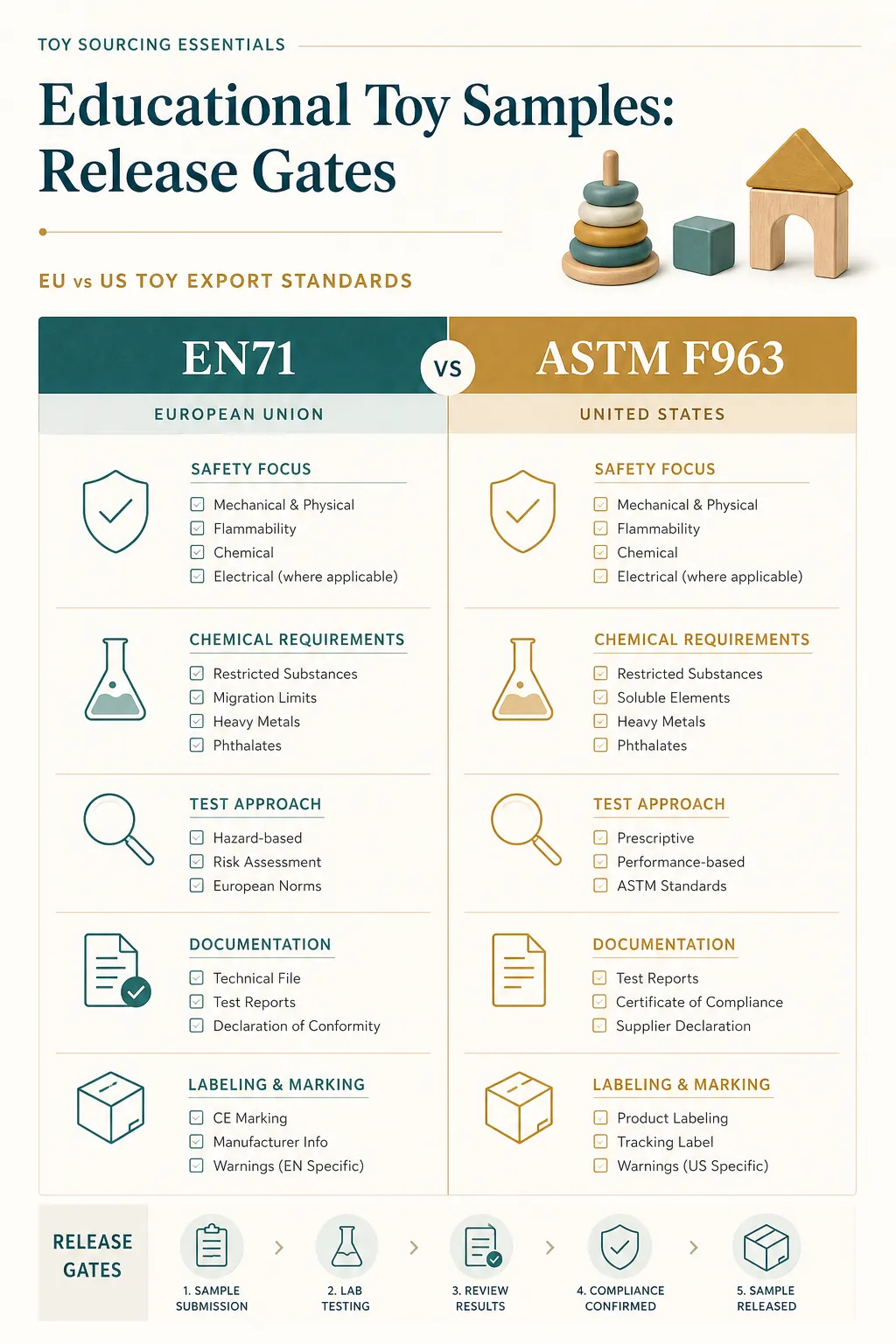
Why release gates matter for mixed classroom sample packs
A mixed classroom sample pack bundles several SKUs—say, a talking flash card reader, a shape sorter, a memory game, and a magnetic drawing board. Each item carries its own age grade, materials, and risk profile. Approving the pack as a single unit can hide a small-part hazard in one component or a color mismatch that signals process drift in another. Release gates force you to evaluate each SKU on its own evidence before the pack moves to pilot production. According to the EU Toy Safety Directive 2009/48/EC, toys placed on the EU market must meet applicable essential safety requirements; the CE marking and EU Declaration of Conformity belong to the conformity process and must be matched to the product scope. In the US, children's toys generally require testing at a CPSC-accepted laboratory and a Children's Product Certificate, per CPSC business guidance. A release gate is the factory's internal checkpoint that mirrors these requirements—it is a quality check, not a substitute for formal testing.
What should I verify before ordering educational toy samples from a new supplier?
Verify supplier qualification first, and do not skip it. Supplier qualification should evaluate capability, material control, quality records, compliance evidence, capacity claims, and subcontracting rather than relying on a catalog page. You are looking for documented proof that the factory can hold tolerances, trace materials, and back up its output with records. If one SKU is produced across factories or lots, the split should be visible in the order, carton code, and compliance evidence—so ask for a traceability matrix early. Also, separate the quote scope: a toy quote should separate tooling, samples, production parts, decoration, testing, packaging, freight, and taxes so the comparison is meaningful. A low per-unit price that buries tooling and testing costs is a red flag. For mixed packs, confirm the age grading and small-part risk for each actual configuration, including assemblies, detachable accessories, and packaging components—the CPSC small parts guidance makes clear these need the same review discipline. If you cannot get clear answers on these, the sample is not ready for release.
How do I approve production parts against the golden sample?
Once the supplier passes qualification, the next gate is production-part approval. This is where you compare the first released parts against the signed drawing, golden sample, and applicable safety test sample. Do not accept a photo or a verbal 'it matches.' The approved sample must be a physical, identified reference—not a loose reference photo—especially for color, texture, logo, and assembly. If the golden sample itself is ambiguous, you have no baseline. For mixed packs, each component needs its own approval; a pack-level sign-off is meaningless if one part drifts. Also, confirm that the safety test sample corresponds to the same configuration as the production part. If the tested sample had a different battery compartment or an extra accessory, the report may not cover what you are about to ship. This gate is your last chance to catch a deviation before tooling is locked and pilot runs begin.
Which certifications should I look for on educational toy samples?
Certification names vary by market, and the right one depends on where you sell. For the EU, the Toy Safety Directive 2009/48/EC sets essential safety requirements covering physical/mechanical, flammability, chemical, electrical, hygiene, and radioactivity risks. CE marking and an EU Declaration of Conformity are part of the conformity process and must be matched to the product scope—they are not a quality badge. For the US, children's products intended primarily for children 12 and under generally require third-party testing at a CPSC-accepted laboratory and a Children's Product Certificate (CPC). The CPC must be in English and include seven elements: product identification, citation to applicable safety rules, manufacturer/importer identification, contact for test records, date and place of manufacture, date and place of testing, and identification of the CPSC-accepted lab. It is product-specific, not a blanket factory certificate. Also, the General Product Safety Regulation (EU) 2023/988 is a separate legal instrument from the Toy Safety Directive; it imposes a general safety requirement and covers online and distance selling, so importer, manufacturer, and product-identification information must be mapped to your market role. A buyer should ask for the test report that identifies the product configuration, age grade, and standard edition—the applicable edition must be read from the current regulation before quoting it. And remember: no standard or guidance page certifies a specific factory or SKU. The absence of a recall in the CPSC database is not a safety certification; it is only a screening step.
Standards and documents to verify per market
| EU – Toy Safety Directive 2009/48/EC | Essential safety requirements for toys placed on the EU market; CE marking and EU Declaration of Conformity must match product scope. |
|---|---|
| EU – General Product Safety Regulation (EU) 2023/988 | Horizontal safety framework; separate from Toy Safety Directive; general safety requirement and obligations for economic operators. |
| US – ASTM F963 (16 CFR Part 1250) | Mandatory consumer product safety standard for children's toys; applicable edition must be read from current regulation. |
| US – Children's Product Certificate (CPC) | Product-specific certificate based on testing at a CPSC-accepted lab; identifies applicable rules and responsible parties. |
| US – Tracking labels | Permanent tracking information supporting product identification; review packaging, markings, and lot control together. |
| US – Small parts ban (16 CFR Part 1501) | Prevents choking hazards for children under 3; assess age grading and small-part risk for actual configuration. |
How do I check color and material consistency across sample packs?
Check color and material consistency as a separate gate because appearance is a process-control signal. Color matching should use the same resin grade, surface finish, lighting condition, and approved master sample because appearance changes with all four variables. If a red part shifts hue between lots, the factory likely changed resin grade or processing parameters—a red flag for quality control. For mixed packs, you may have several plastic parts that need to match within a set; a mismatch is both a cosmetic defect and a potential compliance issue if the material change alters chemical properties. Ask the supplier for the resin grade and process parameters used for the golden sample, and require that production lots use the same. A simple visual check under consistent lighting is the cheapest way to catch a drift before it becomes a batch problem.
How should I document the release for pilot orders?
Documentation is your defense if a problem surfaces. At minimum, you need a release record that ties each SKU to its drawing, golden sample, safety test sample, and compliance evidence. For the EU, that includes the CE marking and Declaration of Conformity; for the US, the CPC and tracking labels. If a SKU is produced across factories or lots, the split must be visible in the order, carton code, and compliance evidence. Also, keep a record of your supplier qualification evaluation—capability, material control, quality records, compliance evidence, capacity claims, and subcontracting. This is not just bureaucracy; it is the proof you will need if a regulator asks about due diligence. And remember, the recall database check is a screening step, not a certification—document that you performed it, but do not treat absence of recalls as proof of compliance. When you move to pilot production, use the same evidence to set your incoming inspection criteria.
FAQ
Which safety certifications should I verify before placing a wholesale order for educational toys from overseas?
For the EU, verify CE marking and an EU Declaration of Conformity under Directive 2009/48/EC; for the US, require a Children's Product Certificate based on testing at a CPSC-accepted laboratory. Confirm the test report matches the product configuration, age grade, and standard edition.
What should I check in a supplier's quality records before approving samples?
Evaluate capability, material control, quality records, compliance evidence, capacity claims, and subcontracting. Ask for traceability of each SKU, including lot splits, and ensure the quote separates tooling, samples, testing, and packaging for a meaningful comparison.
How many samples do I need to approve a mixed classroom pack?
The number is not fixed by regulation; it depends on the SKU count and risk. Each component must have its own approved sample against the drawing, golden sample, and safety test sample. Confirm the sample quantity with your supplier based on your inspection plan.
Can I rely on a factory's CE/CPC certificate as proof of compliance?
No. CE marking and a CPC are product-specific and must be matched to the specific SKU, report, responsible party, and current regulation edition. A standard or guidance page does not certify a factory or SKU.
What is the difference between the EU Toy Safety Directive and the GPSR for my sample pack?
The Toy Safety Directive sets essential safety requirements for toys; the General Product Safety Regulation (EU) 2023/988 is a separate horizontal instrument with a general safety requirement. Both may apply, so map importer, manufacturer, and product-identification information to your market role.
How do I handle small parts in a mixed pack for children under 3?
Assess age grading and small-part risk for each actual configuration, including assemblies, detachable accessories, and packaging components. Use the small parts cylinder test and ensure use-and-abuse testing (impact, torque, tension, compression) is performed by a CPSC-accepted lab.
Sources
Related Products & Categories
Request Certificates
Ready to move from sample approval to pilot order? Request the specific compliance documents for each SKU—CE/DoC, CPC, and test reports—and verify they match your target market. For classroom and active play needs, explore our Active Play & Classroom Games collection for vetted options.