
Card Readers and Flash Card Machines at the Hong Kong Toy Fair: Content, Buttons, and Power
Plan your 2027 Hong Kong Toys & Games Fair shortlist with six real card machines: compare teaching content, buttons, included batteries and classroom fit.
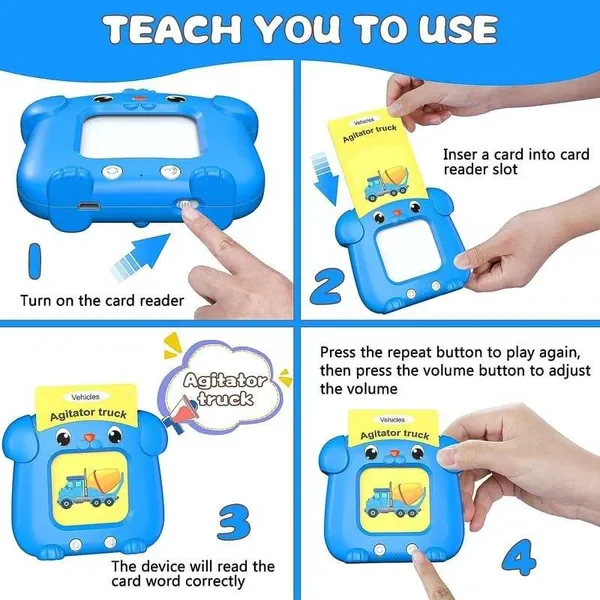
How do you compare talking card machines on what they teach, how a child operates them and how they are powered? Watch the learning loop, then record the content and power configuration beside it. The Cat reader offers a useful starting point: its instructions describe holding the volume button for 1 second, inserting a card to hear it, then pressing repeat to listen again.
For your Hong Kong toy fair flash card machine shortlist, that sequence is more revealing than a large vocabulary badge. Can the child repeat a word without restarting? Does the activity stop at naming a picture, or invite a spelling attempt?
The six models below are catalogue references for planning supplier conversations, not confirmed 2027 exhibits; functions are listing descriptions rather than hands-on results.
Make educational readers a specific fair mission
The Hong Kong Toys & Games Fair runs January 11–14, 2027, at the Hong Kong Convention and Exhibition Centre. Begin with Educational Toys & Games in the , with Electronic & Remote Control Toys as another relevant sourcing category.
The concurrent Stationery & School Supplies Fair gives education buyers an adjacent reason to visit: the reader can be considered alongside a wider classroom assortment. These are programme directions, not booth locations.
For arrival planning, places Exhibition Centre MTR, Wan Chai MTR and Wan Chai ferry pier within a 10-minute walk. Keep the first supplier conversation focused on an activity—picture naming, spelling or bilingual listening—rather than the loose label “early learning.”
What do the cards actually teach?
The useful distinction is between picture vocabulary, letter-based spelling and named bilingual content—not simply the largest advertised word total. CPS287351 leads with “384 sight words” in its catalogue title, making it the high-vocabulary reference in this shortlist.
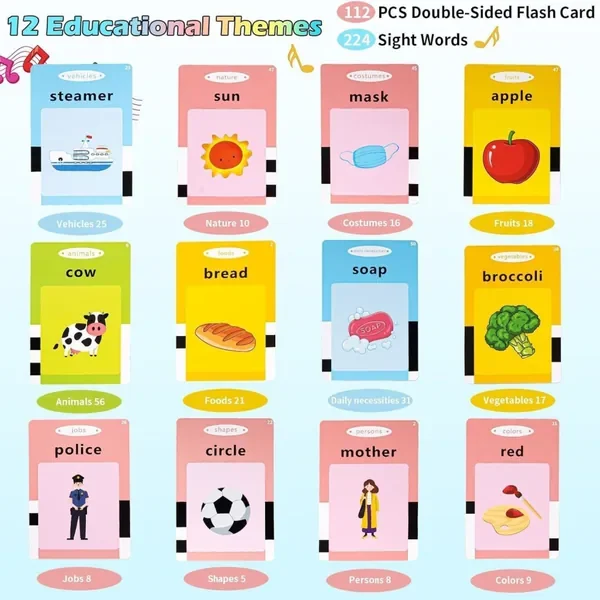
The Bear CPS282279 specifies 112 double-sided cards. Its advertised 224 words describe the content carried across those card faces, rather than a separate stack for every word.
The Cat CPS282283 also lists 112 double-sided cards and 224 words. Its description names animals, fruits, vehicles and jobs, with matching sounds for examples such as animals and vehicles.
Those subjects suggest picture-naming and listening activities; they should not automatically be treated as a sequenced high-frequency reading curriculum. At the fair, ask the demonstrator to fan cards by subject, then reverse the card being played. Watch which picture remains visible in the slot and whether the spoken response matches the face the learner is attending to.
A smaller word-card stack can offer a deeper activity
The CPS334027 Flash Card Machine lists 107 word cards. It adds 52 letter cards for spelling work, rather than relying only on picture-word playback.
Its 6 songs are audio content, not additional physical cards. More importantly for a classroom buyer, the listing describes spelling and arithmetic modes, voice prompts and praise for correct answers.
For spelling errors, the described response is a soft reminder sound. Make that feedback part of the fair demonstration: request an incorrect spelling attempt, listen to the response and watch how the next attempt begins. Then see the arithmetic activity rather than accepting a song demonstration as a substitute.
The attraction is the change in learning task: insert-and-listen becomes attempt-and-receive-feedback. That earns it a different place on the shortlist, without needing to call it universally “more educational.”
Compare the slot, the replay control and the physical footprint
Cat's original instructions specify automatic pronunciation on insertion and a repeat button; Bear's original brief only specifies one-button operation. Keep those levels of detail separate when comparing the controls, rather than copying the Cat's instructions to the Bear.
Both list reader dimensions of 10.5 × 9 × 2.2 cm. Their individual retail packages measure 17.7 × 9.6 × 4.7 cm: use the body measurement for a classroom tray and the package measurement for boxed storage.
The CPS287930 Camera Talking Flash Cards provides a contrasting housing for a talking-card activity; its original brief does not describe a complete insertion-and-replay sequence. The camera styling is the shape of the reader, not a stated photography function. Watch how that body presents the slot and where the learner's fingers naturally sit.
The Russian + English CPS349384 also lists a 10.5 × 9 × 2.2 cm reader. Its retail package is 17.7 × 9.7 × 4.6 cm, a useful reminder to keep device and packaging measurements in separate fields.
The 384-word CPS287351 listing records a 23 × 4 × 10.5 cm color box and 72 packaged units per carton. These are useful storage and purchasing facts even though its title supplies no verified card inventory; retain the word claim as a catalogue title rather than converting it into a card count.
Keep language and charging accessories beside the SKU
The CPS349384 Russian + English reader describes card-triggered bilingual playback and Q&A audio. Its fair demonstration should therefore include both named languages and a question-and-answer interaction, not just an isolated English word.
Bear's catalogue title lists an included 3.7V battery, without specifying its chemistry, rechargeability or cable. Cat's original description specifies a 3.7V rechargeable lithium battery and an included charging cable; that is the documented charging reference here.
The bilingual reader specifies a rechargeable lithium battery with a USB charging cable. That accessory belongs in the comparison: a charging lead is a separate item for a school to store and issue, even when the reader itself is rechargeable.
For the spelling machine and camera-style reader, leave the battery field unfilled until the demonstration supplies that information. Do not copy the animal readers' power configuration across the range. Have the device and supplied accessories laid out together so the notes describe an actual set.
The three-column checklist for fair meetings
Use the same observation fields at each relevant demonstration; the purpose is comparable classroom activities, not a vocabulary-count league table.
| Card content | Buttons and slot | Power / battery route |
|---|---|---|
| Name the activity: picture vocabulary, spelling, arithmetic or Russian–English listening. | Identify power, volume and replay before inserting the card. | Record the stated battery configuration and show the charging connection. |
| Fan the cards by subject; examine both faces of a double-sided card. | Watch insertion orientation, visible artwork and replay without replacing the card. | Lay out the included cable and other supplied accessories beside the reader. |
| For interactive models, demonstrate a spelling error or the bilingual Q&A activity. | Record the response and the action needed to continue. | Keep device dimensions, retail-box dimensions and charging accessories in separate fields. |
Bring the real ordering configuration into the conversation
The catalogue minimums distinguish a school-supply assortment discussion from a single-classroom evaluation. Bear lists 120 units across 2 cartons, packed at 60 units per carton.
Cat lists 60 units in 1 carton. The spelling-and-arithmetic machine lists 48 units across 2 cartons, with 24 units per carton.
The bilingual version has a different commercial scale: 360 units across 3 cartons, packed at 120 units per carton. The camera-style reader lists a 60-unit minimum.
These are published catalogue configurations, not sample-order recommendations. Include them in the fair brief so a language-specific reader does not enter the same purchasing discussion as a general vocabulary reader merely because their housings look similar.
Use the fair's matching tools for a demonstration-led meeting
The schedules online sourcing for December 11, 2026–February 10, 2027. Click2Match runs January 4–21, 2027, providing a published matching window around the physical fair.
For relevant supplier conversations, send the activity brief and the checklist rather than a request to “show your educational toys.” At the venue, Scan2Match in the Marketplace App connects exhibitor booth or product QR codes with details, favourites, chat, enquiries and meeting-scheduling functions.
Save the relevant supplier record and use scheduling for a follow-up request; scanning alone is not an accepted appointment. Your demonstration script can stay short: “Insert the card, replay it, show its reverse, then show the power source and supplied cable.” Add the spelling-error or bilingual interaction where applicable.
Next action: start with the official buyer-registration route
Open the and use To Visit to reach buyer registration. procedure covers personal and company details and business-matching information, with an email after successful registration; an upcoming fair may show an information-coming-soon message before registration is ready.