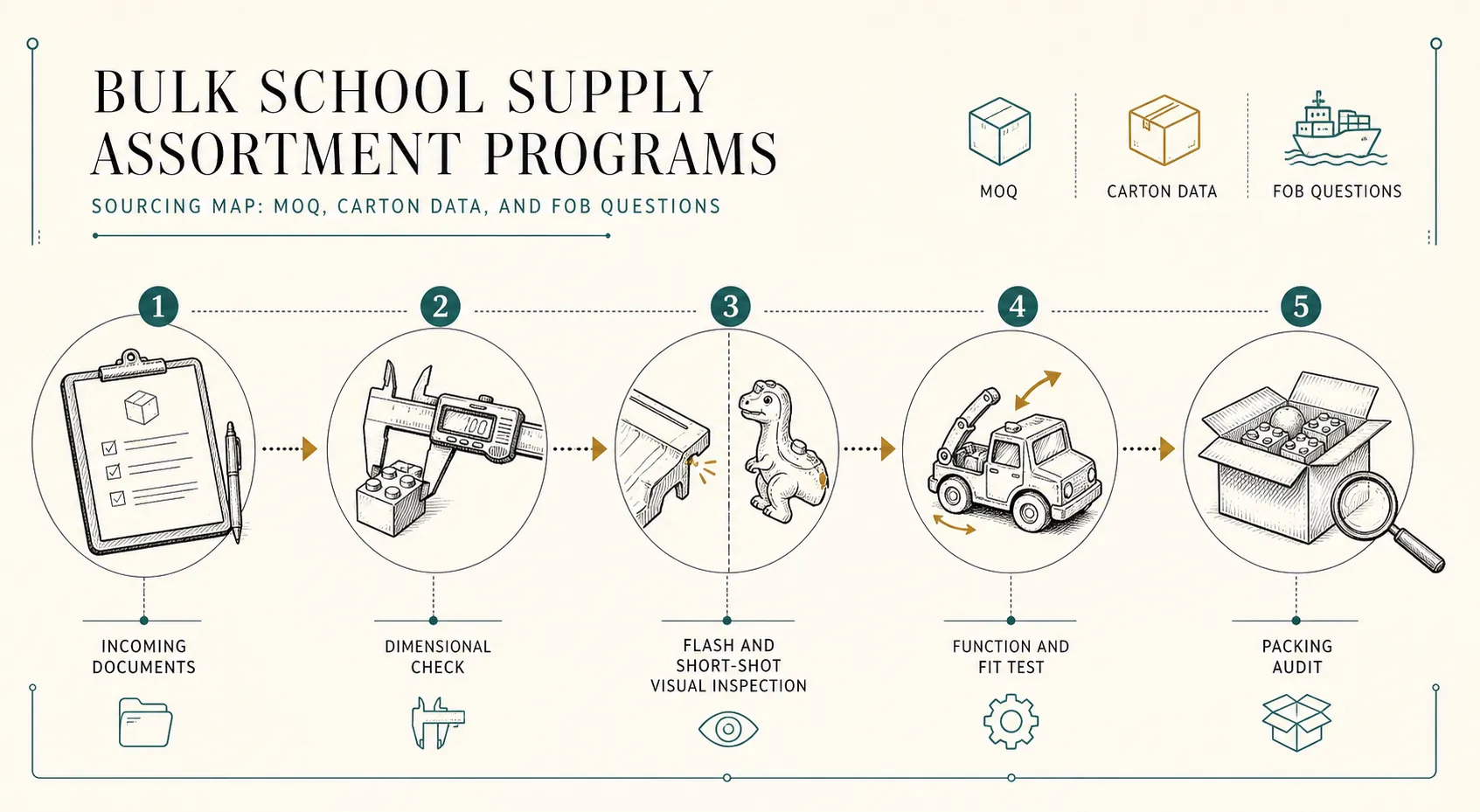
Bulk school supply assortment programs sourcing map: MOQ, carton data and FOB questions
Learn how to source bulk school supply assortments: MOQ, carton data, FOB terms, safety checks, and RFQ questions for institutional buyers.
Ordering on price alone is the fastest way to ruin a bulk school supply program—you discover too late that the MOQ is per SKU, the carton data doesn't match the freight quote, or the FOB terms leave you holding the risk. Before you commit to any assortment, build a sourcing map that covers product fit, packaging and MOQ questions, safety evidence, delivery checks, and a quote-ready next step. Use the checkpoints below to compare suppliers on documentation, not just price per piece.
Key Takeaways
- Always request per-SKU MOQs and per-case pricing, not just a blended assortment price, because suppliers often quote different minimums for mixed vs. single-item cartons.
- Carton data (dimensions, weight, pieces per carton) drives your freight estimate and FOB cost; verify it in writing before you book logistics.
- FOB terms define risk transfer, not safety compliance—you still own the responsibility for destination-market certifications like EN71 or ASTM F963.
- Plan for seasonal restocking: some bulk school supply items are only available in August, so align your order window with back-to-school timelines.
- Ask for a 14-day inspection window in your contract, and clarify who pays return shipping for defective items—this is negotiable, not standard.
Supplier Channels Compared
| US-based institutional distributor (e.g., American Bulk Containers) | MOQ: ~100 units for larger bins; Lead time: 7–10 days; Price: volume-based, not published; Authorized: yes (e.g., Sterilite, Akro-Mils); Ships from: USA |
|---|---|
| Wholesale school supply kit seller (e.g., Backpacks USA) | MOQ: case of 12 kits; Price: volume discounts, free shipping over $60; Authorized: not stated; Ships from: USA |
| Bulk school supply marketplace (e.g., BagsInBulk) | MOQ: no minimum; Price: from $0.22 per item; Authorized: not stated; Ships from: USA |
| Factory-direct from China (educational toy suppliers) | MOQ: varies by SKU (e.g., 48–1440 pieces); Price: FOB quotes typical; Authorized: varies; Ships from: China |
What MOQ and Pricing Tiers Should You Expect?
MOQs for bulk school supply assortments vary dramatically by channel and product type. US-based distributors often start around 100 units for larger items, while kit sellers may require a case of 12. Factory-direct suppliers in China commonly quote per-SKU MOQs, which can range from as low as 48 pieces for a niche educational toy to over 1,000 pieces for low-cost fidget items.
A single MOQ rarely covers an entire assortment. Ask for a per-SKU breakdown: some items may have a higher minimum, and mixing cartons could trigger a different MOQ. Also ask whether the MOQ is per color, per design, or per SKU—this affects your cash outlay and inventory risk.
For pricing tiers, request a price break schedule at 1x, 2x, and 5x the MOQ. This helps you plan for growth and negotiate volume discounts. Remember, the lowest FOB price per unit may not be the best total cost once you factor in carton dimensions, freight, and potential repackaging.
Carton Data: Why It Matters and What to Request
Carton data—dimensions, weight, and pieces per carton—is the backbone of your logistics plan. Without it, you can't accurately estimate freight costs, pallet configurations, or whether your distribution center can handle the shipment.
When requesting quotes, always ask for: carton dimensions (LxWxH), gross and net weight, pieces per carton, and cartons per pallet. For example, a 52-piece school supply kit might come in a case of 12, with item dimensions of 13" x 3" x 10.5"—but that's the item, not the shipping carton. Confirm the carton specs separately.
Some suppliers offer direct access to logistics specialists who can help with pallet dimensions and freight configurations. Take advantage of this—it can prevent costly surprises at the dock. If a supplier can't provide carton data upfront, that's a red flag; move on or demand it in writing before you commit.
FOB Terms: What They Cover and What They Don't
FOB (Free On Board) terms define when risk transfers from seller to buyer—typically when the goods are loaded onto the shipping vessel. But FOB does not define product-safety compliance or ownership of test reports. That's on you as the importer.
Before signing, clarify: Is the quote FOB Shanghai, FOB Ningbo, or another port? Does it include export packing, loading charges, or customs clearance? What happens if the shipment is delayed at the port? These details affect your total landed cost and your ability to hold the supplier accountable.
Also, confirm who owns the test reports. Even if the supplier has EN71 or ASTM F963 reports, you may need your own documentation for customs or retail compliance. Ask for copies and verify they cover the specific products you're ordering, not just a similar item from their catalog.
Safety Evidence and Compliance Checks
Safety compliance is non-negotiable, especially when sourcing from overseas. For the EU, Regulation (EU) 2025/2509 is the enacted toy-safety regulation: it entered into force on 2026-01-01, applies mainly from 2030-08-01, and Articles 28-44 and 49-55 apply from 2026-01-01. Directive 2009/48/EC remains relevant during the transition. For the US, ASTM F963 is the standard, and CPSC enforces it.
For electric toys—like a Bluetooth music mat or a card-based learning machine—ask about insulation, dielectric, and leakage-current checks. These are not optional; they're part of electrical safety testing. A supplier may claim compliance, but you should request the actual test report and verify it covers your exact model and power architecture.
Don't rely solely on a supplier's word. Ask for the test report, the lab name, and the report number. If they can't provide it, consider a third-party inspection before shipment. The cost is usually worth avoiding a customs hold or a retail recall.
Specific product risks matter. For example, educational magnetic sets often fail on pinch points, not on the learning headline. Ask how the supplier tests for pinch and magnet-gap safety. A good supplier will have a documented process, not just a vague promise.
Delivery Checks and Logistics
Lead times vary by channel. US-based distributors often ship within 7–10 days, while factory-direct orders from China typically take 3–6 weeks for production plus 2–4 weeks for ocean freight. Always confirm the lead time in writing, and factor in seasonal peaks—back-to-school orders can delay production if you order too late.
Ask about the shipping method: is it FCL (full container load) or LCL (less than container load)? LCL can be cheaper for small orders but has longer transit times and handling risks. Also, ask about incoterms beyond FOB—CIF, DDP, etc.—and what each includes. DDP might simplify customs, but it shifts more responsibility to the supplier, which can affect price.
Build inspection into your timeline, whether you use a third-party inspector or do a self-check. A 14-day inspection window is typical for returns, but that's from receipt, not from order. Clarify the window and the return shipping responsibility before you pay.
Worked Example (Illustrative, Not a Real Shipment)
Let's walk through a hypothetical order to see how these checkpoints play out. Imagine you're sourcing a bulk order of 5,000 educational supply kits for a school district in Texas. You're comparing two suppliers: one US-based, one factory-direct from China.
The US supplier quotes a case of 12 kits, FOB their warehouse, with a 7–10 day lead time. They provide carton data: each case weighs 15 lbs, dimensions 24" x 18" x 18". You order 417 cases (about 5,000 kits), and freight is straightforward—ground shipping, no customs. Your risk: minimal, but you pay a higher per-unit price, say $3.50 per kit.
The Chinese supplier quotes FOB Ningbo at $2.00 per kit, with a 30-day production time plus 25 days for ocean freight. They provide carton dimensions: 20" x 15" x 12", 10 lbs per carton, 12 kits per carton. You order 417 cartons, but you need to factor in freight cost, customs clearance, and potential inspection. Your total landed cost might be $2.80 per kit, but you also need to manage the longer lead time and the risk of delays.
Which is better? It depends on your budget, timeline, and tolerance for risk. The US supplier offers speed and simplicity; the Chinese supplier offers cost savings but requires more hands-on management. In this scenario, if you have 8 weeks to delivery, the Chinese option could work—but only if you've verified the safety reports and carton data in advance.
This example is illustrative, not a real shipment. Use it as a template for your own comparison—always request detailed quotes and verify the numbers before you commit.
What to Ask Suppliers in Your RFQ
When you're ready to send an RFQ, include these specific questions to get comparable quotes:
1. What is the MOQ per SKU and per mixed carton?
2. What are the carton dimensions, gross weight, and pieces per carton?
3. What is the FOB price per unit and per carton? Does it include export packing?
4. What is the lead time for production and delivery?
5. Can you provide the test reports for EN71, ASTM F963, or other relevant standards?
6. Do you offer custom packaging or branding? What are the design file requirements?
7. What is your inspection and return policy? Who pays for return shipping on defective items?
8. Can you provide references from other institutional buyers?
9. What is your payment terms (e.g., T/T, L/C)?
10. Do you have a logistics partner who can help with freight configuration?
FAQ
What minimum order quantities and pricing tiers do Chinese suppliers typically require for educational toys wholesale?
Chinese suppliers often set per-SKU MOQs ranging from 48 to 1,440 pieces, depending on the product. Pricing tiers usually lower the per-unit cost as volume increases, but you must request a price break schedule. Confirm whether the MOQ is per color or design, as that can affect your order.
What are the typical lead times and shipping costs for bulk educational toys wholesale orders from Asia to a US distribution center?
Production typically takes 3–6 weeks, plus 2–4 weeks for ocean freight. Shipping costs depend on carton dimensions and weight, so always request carton data to estimate freight. LCL is cheaper for small orders but slower; FCL is faster but requires a full container.
Can educational toys wholesale suppliers offer custom packaging and branding for retail-ready products, and what are the common design file requirements?
Yes, many suppliers offer OEM packaging. Common design file requirements include AI or PDF formats, CMYK color mode, 300 DPI resolution, and die-cut lines. Confirm the MOQ for custom packaging, as it may be higher than for standard packaging.
What should importers check before sourcing STEM toys wholesale from China?
Check the supplier's safety test reports (EN71, ASTM F963), the MOQ per SKU, carton data, FOB terms, and the lead time. Also, verify the supplier's experience with STEM toys and ask about any specific safety risks, like small parts or magnets. Always request a sample before bulk ordering.
What MOQ, pricing, and packaging details should buyers confirm for STEM toys wholesale?
Confirm the MOQ per SKU and per color, the FOB price per unit, carton dimensions and weight, and packaging specifications. Ask for a price break at 1x, 2x, and 5x MOQ. Also, confirm whether the packaging is retail-ready and what design files you need to provide.
Sources
Related Products & Categories
Request a Quote
Ready to source your next bulk school supply assortment? Prepare your RFQ with the questions above, then reach out to suppliers with clear specifications. If you're evaluating educational toy assortments, consider requesting a sample carton to verify quality and carton data before committing to a full order.