
Bulk Pop It Toys and Logic Boards: Turning Simple Push Bubbles Into Structured Counting Games
Turn bulk pop it toys into nim-style counting games. Compare 5x5, 6x6 and 10x10 grids, quiet classroom use, washability, CPC compliance and MOQ 300 carton math.
Thirty seconds, two players, one pop it grid: Player A presses 1, 2, or 3 adjacent bubbles. Player B does the same. The player who presses the last bubble wins. That single rule turns a bulk pop it toy from an impulse fidget into a nim-style counting board that fits a 5-minute classroom transition, and it gives school suppliers a concrete way to sell bulk pop it toys as math manipulatives rather than novelty stock.
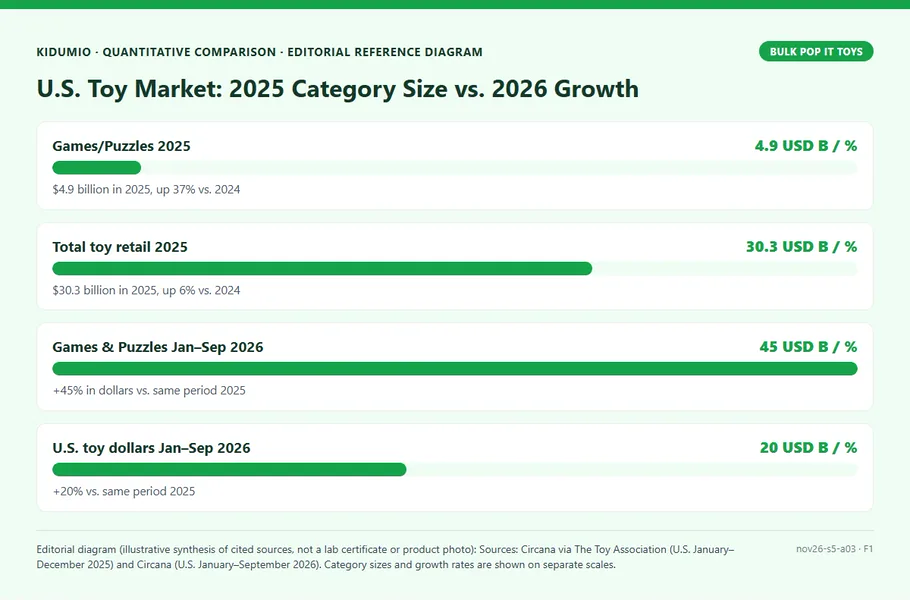
The commercial case is not fringe. Games/Puzzles was the largest U.S. toy supercategory in 2025 at $4.9 billion, up 37% vs. 2024, inside a total U.S. toy retail market of $30.3 billion, up 6% . ed U.S. toy dollar sales up +20% from January through September 2026, unit sales up +18%, and average selling price up +2%, with Games & Puzzles up +45% in dollars over the same 9-month window . For a buyer assembling a classroom logic-board program, the job is to choose grid geometry, noise profile, washability and compliance documents before committing cartons.
Grid Geometry: How 25, 36 and 100 Bubbles Change the Game
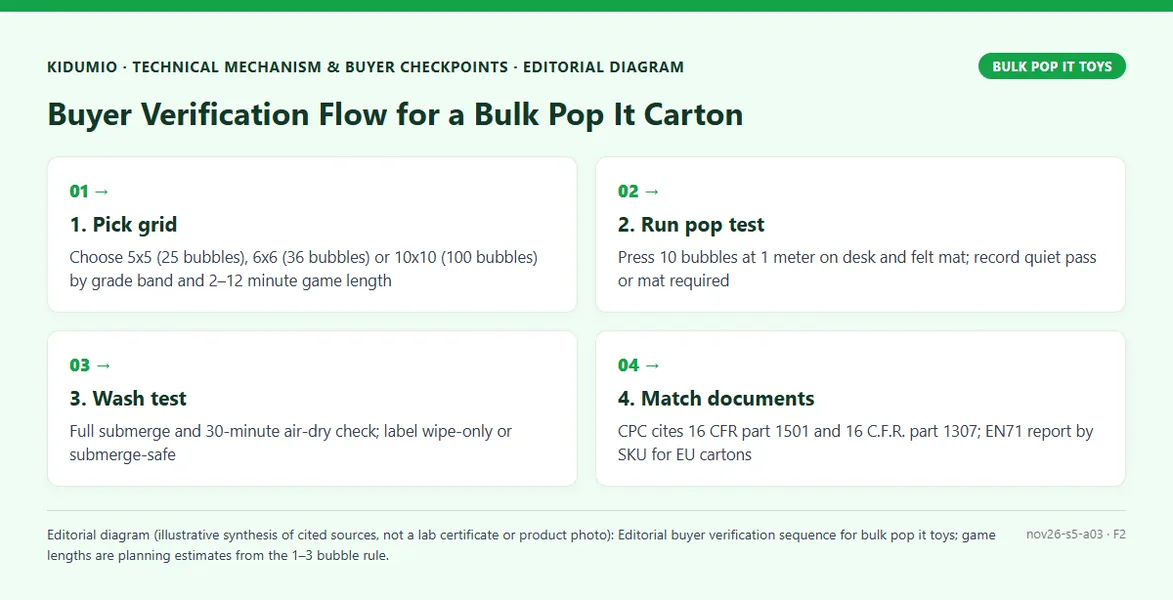
A 5x5 grid carries 25 bubbles. Under the 1–3 adjacent-bubble rule, a full board resolves in roughly 9–25 turns, which maps to a 2–4 minute game for K–2 counting practice. A 6x6 grid carries 36 bubbles and resolves in roughly 12–36 turns, or 4–6 minutes, which suits grades 1–3 turn-taking. A 10x10 grid carries 100 bubbles and resolves in roughly 34–100 turns, or 8–12 minutes, which fits grades 3–5 strategy and nim work. These are illustrative planning figures derived from the game rule, not timed classroom trials.
The arithmetic is simple enough to print on a teacher card: bubbles per board divided by 3 gives the minimum turn count, and bubbles per board divided by 1 gives the maximum. A 6x6 board therefore has a 36-turn ceiling and a 12-turn floor, a tighter scheduling window than a 10x10 board with a 100-turn ceiling. Buyers who stock one grid size for a whole school should default to 6x6 because it covers the widest grade band without exceeding a 6-minute center rotation.
notes that manipulative play builds sensory-motor skills and spatial understanding, and that turn-taking interactions strengthen communication and social skills . That is the citable rationale for labeling a pop it grid as a structured counting tool: the board supplies the turn structure, and the 1–3 press rule supplies the counting decision.
Quiet Classroom Use: Bubble Depth, Material and the Pop Test
Pop noise comes from three physical variables: bubble wall thickness, air displacement under the dome, and the hardness of the surface the board sits on. A silicone board with deeper, softer domes produces a lower-amplitude pop than a thin rigid plastic sheet of the same diameter, and a board placed on a felt mat reduces tabletop resonance. The American Academy of Pediatrics advises avoiding toys that are loud to prevent hearing damage , so a school supplier should treat noise as a specification, not an afterthought.
Run a 3-sample pop test before approving a carton: place the board on a desk, press 10 bubbles at a normal child's force, and listen from 1 meter away. Reject any sample whose pop is audible over normal classroom conversation at that distance, and repeat the test on a felt mat. Record the result on the SKU sheet as 'quiet — desk test pass' or 'quiet — mat required' so teachers can plan centers accordingly.
The Toy Association's 2026 trends report identifies 'Cozy Culture' — tech-free toys that engage the senses — and notes kidults account for roughly one-quarter of U.S. toy sales . A quiet, screen-free pop it board fits that trend on both sides of the buyer base: early-grade classrooms and adult collectors who use tactile boards for focus.
Washability and Shared-Set Hygiene: What to Verify on a Sample
Shared classroom sets need a documented cleaning cycle, not a vague 'wipe clean' claim. Verify three fields on the sample: surface material (silicone versus rigid plastic), whether the board has an open back that traps water, and the air-dry time after a full submerge. A board with a sealed back dries in a shorter window than a hollow-backed board, and a silicone board tolerates repeated washing better than a thin plastic sheet that creases at the hinge.
Set a rotation schedule around the drying time: if a full submerge test leaves visible water in the domes after 30 minutes of air-drying, the SKU is a wipe-only board and should be labeled as such. A wipe-only board supports a 3-minute wipe between class rotations; a submerge-safe board supports end-of-day washing. Put that distinction on the carton label so the school's custodial team uses the right method.
The American Academy of Pediatrics notes that fine-motor and manipulative toys such as blocks, shapes, puzzles and trains support fine motor skills and early math skills . A washable pop it board extends that manipulative category into shared classroom use, where hygiene rotation is part of the product specification.
Compliance for Fidget Toys Wholesale: CPC Citations, Age Labels and EN71
For U.S.-bound cartons, the Children's Product Certificate must cite the small-parts rule as '16 CFR part 1501 – Small parts' when the SKU is intended for children under 3, and the phthalates rule as '16 C.F.R. part 1307 – Phthalates' with a 0.1% (1000 ppm) limit in accessible plasticized components CPSC — Small Parts Ban CPSC — Phthalates Business Guidance. A pop it board intended for age 3+ still needs the phthalates citation, and any detachable bubble or keychain clip must pass the small-parts cylinder test.
Age labeling is the buyer's first filter. A board marketed to K–2 classrooms sits close to the under-3 boundary, so the carton must carry the correct choking-hazard warning and the CPC must match the labeled age. The choking-hazard warning label requirement is codified at 16 C.F.R. § 1500.19, and any advertising for children's toys subject to that requirement must use the same warning per 16 C.F.R. § 1500.20. The CPSC states that the choking hazard warning label requirement does not need to be included in a CPC, so the CPC section 2 citation line carries the small-parts rule and the phthalates rule, while the warning itself lives on the carton and in the advertising.
For EU-bound cartons, the Kidumio supplier-stated profile lists EN71 certification; treat that as a supplier-stated claim and request the EN71 test report by SKU and colorway before booking. Kidumio's stated MOQ is 300 units, lead time is 25–35 days, and monthly capacity is 8000 pcs, all supplier-stated and not third-party verified Kidumio — supplier profile. Chenghai, Shantou, the production base behind much of the global plastic toy supply, reports about 68,100 toy business entities and 2025 full-chain toy output value above RMB 50 billion Shantou Federation of Industry and Commerce — Chenghai toy report, which is why document coordination belongs in the purchase order, not in a post-arrival email.
5x5 vs. 6x6 vs. 10x10 Pop It Grids for Classroom Buyers
The table below compares three grid sizes on the variables a school supplier can verify before a carton commitment: players per board, illustrative game length, noise level, washability check and best classroom use. Game lengths are planning estimates from the 1–3 bubble rule, not timed trials.
| Grid size | Noise level | Players per board | Washability check | Best classroom use | Illustrative game length |
|---|---|---|---|---|---|
| 5x5 (25 bubbles) | Low | 2 | Wipe-and-dry test | K–2 counting turns | 2–4 minutes (9–25 turns) |
| 6x6 (36 bubbles) | Low–medium | 2–3 | Rinse and air-dry | Grades 1–3 turn-taking | 4–6 minutes (12–36 turns) |
| 10x10 (100 bubbles) | Medium | 2–4 | Full submerge test | Grades 3–5 strategy and nim | 8–12 minutes (34–100 turns) |
Carton Math: MOQ 300, Per-Student Cost and Replacement Budget
Kidumio's supplier-stated MOQ is 300 units. Spread across 10 classrooms of 30 students, that is 300 / (30 × 10) = 1.0 unit per student. At an illustrative carton cost of $600, cost per student is $600 / 300 = $2.00. This is a planning example, not a price quote; the actual carton cost comes from the quotation.
Replacement budgeting follows the same roster logic. If a classroom set of 30 units loses 10% of pieces per school year, the replacement need is 3 units per classroom per year, or 30 units across 10 classrooms. That is one-tenth of a 300-unit carton, so a buyer running 10 classrooms should plan a 10% reserve inside the first order rather than a second small order later.
Lead time shapes the calendar. At a supplier-stated 25–35 day lead time, an order placed in early July lands between late July and mid-August, which clears most U.S. district start dates. An order placed in late August lands in late September, after the first classroom rotation. The purchase order should state the ship window, the carton pack count and the per-classroom allocation, not just the total unit count.
The 30-Second Teacher Card: Rule, Grid and Reset
Print this on the carton insert: 'Two players. Press 1, 2 or 3 adjacent bubbles on your turn. The player who presses the last bubble wins.' On a 5x5 board the game ends in 9–25 turns, on a 6x6 board in 12–36 turns, and on a 10x10 board in 34–100 turns. Reset is a full-board press in one pass, which takes under 30 seconds on a 6x6 board. Pair the card with the CPC citation line and the washability method so the teacher, the custodian and the buyer all read the same specification.
Are bulk pop it toys suitable for classroom counting games?
Yes. A 5x5 or 6x6 grid supports two-player nim-style counting in 2–6 minutes when the SKU carries age-appropriate small-parts labeling and a printed 1–3 bubble rule. The 6x6 grid is the safest single-SKU choice because its 12–36 turn range covers grades 1–3 without exceeding a 6-minute center rotation.
What should a school supplier check before buying fidget toys wholesale?
Request the CPC citations for small parts (16 CFR part 1501) and phthalates (16 C.F.R. part 1307), confirm the age label matches the CPC, and run a 3-sample pop test and a full submerge test on the sample. Add the EN71 test report by SKU and colorway for EU-bound cartons, and record the drying time on the SKU sheet.
How many pop it toys come in a bulk order?
Kidumio's stated minimum order quantity is 300 units, which covers ten 30-student classrooms at one unit per child. Confirm carton pack counts and the 25–35 day lead time at quotation, and plan a 10% replacement reserve of 30 units for a 10-classroom program.
Build a Logic-Board Carton for Your Classrooms
Kidumio's catalog desk supports school suppliers and educational distributors buying by the carton, with SKU-level carton data, OEM packaging options and destination-market compliance document coordination. Start with a 6x6 sample set, run the pop test and submerge test, and match the CPC citations to the age label before booking the 300-unit MOQ. The supplier-stated 25–35 day lead time gives a July order a late-July to mid-August landing window for fall classroom rotation.
Sources
www.cpsc.gov — Small Parts Ban and Choking Hazard Labeling | CPSC.gov
www.cpsc.gov — Phthalates Business Guidance | CPSC.gov
stgsl.shantou.gov.cn — 融媒观察 | 澄海把玩具的门开给世_图片新闻_汕头市工商业联合会(总商会)