
Fine Motor Skills Toys: Which to Approve for Classrooms?
Compare a 42-piece building set and dinosaur shape sorter, then record classroom fit, sharing limits, sample checks, and destination-file approval.
Shortlist the 42-piece building set for open-ended construction and the dinosaur shape sorter for a defined fitting task, but request sample and destination-file review before approving either for classroom purchase. For fine motor skills toys, the useful distinction is what children manipulate and whether a complete activity remains available when a set is shared. Record the intended age and skill level, classroom activity, and children per set before comparing order quantities or packaging.
A destination file is the item-specific approval record for a named market and classroom use. It should connect the selected product, reviewed sample, purchasing specification, relevant documents, and final release decision—not simply collect certificates.
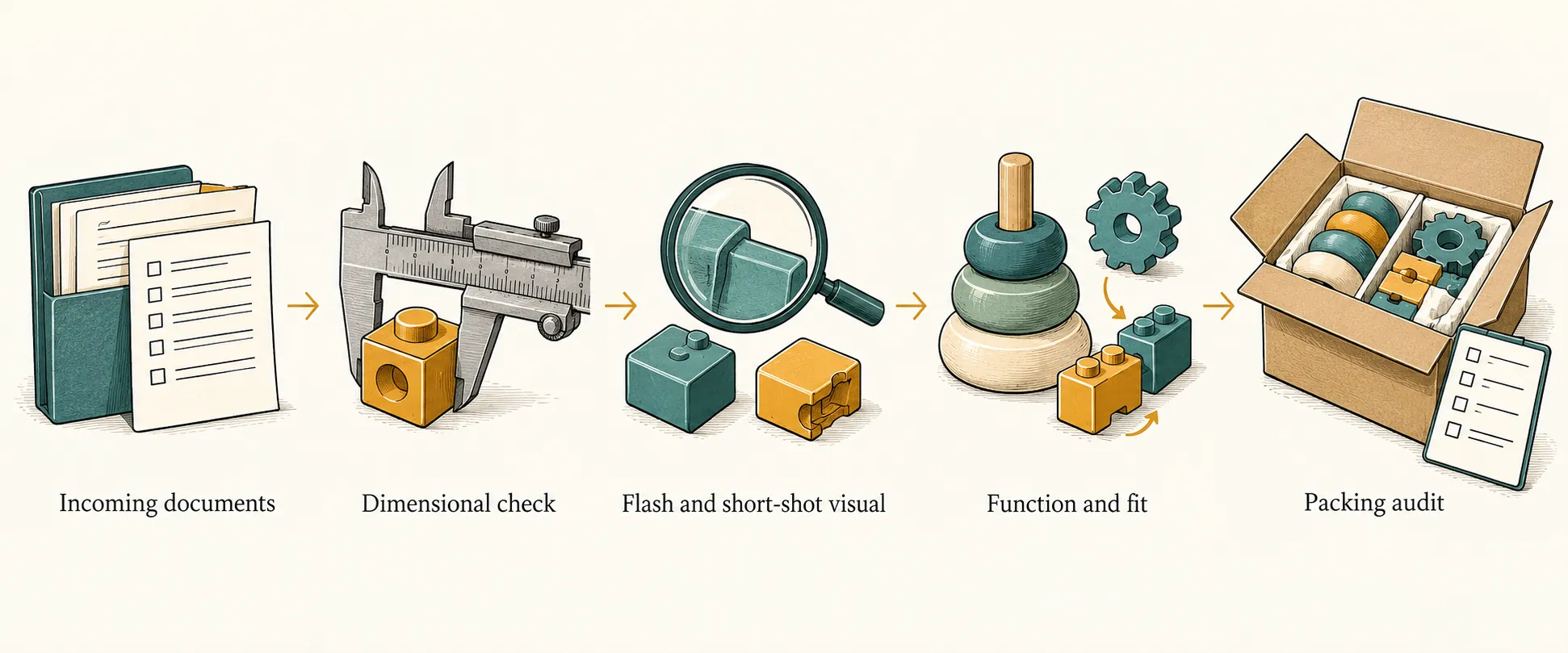
Which product mechanism fits the classroom activity?
| DIY Soft Building Blocks — 42 Pieces | Model CPS348705 | Recorded material: ABS. Packing: display box. Reference MOQ: 480 units. Units per carton: 48. |
|---|---|
| Dinosaur Shape Sorter Toys | Model CPS349393 | Recorded material: ABS. Packing code: C/B; request a plain-language packaging description and pack photographs. Reference MOQ: 144 units. Units per carton: 48. |
| Building-set selection criterion | Select for a construction brief. Ask the sample reviewer to demonstrate how the pieces assemble and separate, identify the different component types, and confirm the advertised 42-piece contents. |
| Shape-sorter selection criterion | Select for a defined matching-and-placement brief. Demonstrate each supplied shape's intended fit and how the sorter is emptied or reset for the next turn. |
What age, skill, and sharing target should the buyer specify?
Specify the intended age band, manipulation task, and simultaneous users as buyer requirements; do not infer them from the product name or piece count.
For the building set, define whether the activity is free construction, copying a teacher's model, or taking turns adding pieces. Ask the reviewer to observe grasping, alignment, assembly, and separation with the actual components. The word “Soft” in the catalog name does not establish the whole toy's construction or feel, and the ABS entry does not resolve that question.
For the dinosaur sorter, specify whether children will match shapes independently or participate in a teacher-led turn-taking activity. Review the effort needed to place and retrieve pieces, access to the sorter, and the steps needed to reset it. These are classroom-use observations, not proof of developmental benefit or substitutes for safety assessment.
Use this bounded purchasing example: propose a two-child construction station and a one-child sorting station, with those numbers explicitly recorded as buyer targets—not rated capacities. Accept the building set for the proposed station only if its actual component mix supports the planned activity for both users. Accept the sorter for the proposed station only if one user can complete and reset the activity as intended. If the sample supports a different arrangement, revise the classroom brief before approval.
Do not divide 42 by the number of children to establish sharing capacity. Equal piece counts may still leave one child without the components needed for a complete activity. Likewise, neither a display box nor a retail packing code establishes reusable classroom storage.
What should each destination-file worksheet record?
| Identity and revision | Record the model identifier, product name, destination country, buyer specification revision, sample identifier, packaging artwork revision, and review date. Attach photographs that connect the reviewed sample to the file. |
|---|---|
| Specified classroom target | Enter the intended age band, skill prerequisites, activity, supervision arrangement, simultaneous users, and whether the set must remain complete between sessions. Treat the proposed age band as a requirement to assess, not an approved age claim. |
| Building-set observation | Count and identify the 42 advertised pieces. Record the actual assembly mechanism, manipulation effort, and whether the planned activity works for the specified users. Describe the observed construction and feel rather than relying on the word “Soft.” |
| Shape-sorter observation | Inventory the supplied shapes and sorter components. Record fitting, retrieval, reset, and access during the intended activity. Note whether sharing requires sequential turns or permits simultaneous participation. |
| Classroom recovery and storage | Demonstrate collection and recounting after the activity. Specify any required reusable container and request cleaning instructions for the actual product construction. |
| Current commercial confirmation | Request a dated quote naming the model, contents, packaging revision, order quantity, current MOQ, and carton quantity. Reconfirm the recorded reference MOQs of 480 units for the building set and 144 units for the sorter, and the recorded 48 units per carton for each. |
| Age and destination review | Request the proposed age labeling, its supporting assessment, relevant instructions and warnings, and the documents selected for the named destination. Compare their product descriptions with the sample and purchasing specification. |
| Decision and closure | Enter approve, hold, or request information; list conditions individually; assign each condition an owner and due date. Record the responsible approver, decision date, closure evidence, closure date, and any revised approval. |
How should destination documents match the selected toy?
Match the document's covered product to the selected construction and model; a broad category description alone does not establish coverage of the classroom assortment.
For US children's products requiring a Children's Product Certificate, CPSC guidance says the certificate must describe the covered product sufficiently to match it to that product. Request the certificate's product identification and applicable rule references, then check that identification against the sample, photographs, and purchasing specification. An internal catalog code need not be the only way to establish identity, but any different model designation should have a clear documented cross-reference. CPSC CPC guidance
For an EU or other destination file, name the country and have the responsible compliance reviewer specify the applicable requirements and documents. Do not treat a US certificate as an interchangeable destination document.
Request supporting test reports where relevant and check their described construction, components, age scope, and applicable rules. Do not demand a new report solely because an internal item code changed, or accept an old report solely because the product name stayed the same. Coverage turns on the product and applicable requirements, not a universal document expiry rule.
Should either item be approved for ordering now?
| DIY Soft Building Blocks — 42 Pieces | Model CPS348705 | Recommended disposition: request information before purchase release. Review target: construction activity, using the proposed two-child station only if sample observations support it. Closure actions: confirm contents and mechanism, assess the age/use brief, settle packaging and current quote, and complete destination-document matching. |
|---|---|
| Dinosaur Shape Sorter Toys | Model CPS349393 | Recommended disposition: request information before purchase release. Review target: matching-and-placement activity, initially assessed as the proposed one-child station. Closure actions: confirm contents, fit and reset operation, assess the age/use brief, clarify C/B packing, and complete current quote and destination-document matching. |
| Responsible approval | Assign the classroom-use reviewer to activity observations, the compliance reviewer to age and destination-document assessment, and the purchasing approver to final release against the named specification revision. Enter each person's name and review date in the actual file. |
| Release, hold, and follow-up | Approve when the defined release conditions are satisfied. Hold when an observed mismatch conflicts with the intended use or destination requirements. For a correctable question, request the specific answer or revision, identify its owner, and record how the condition closes before release. |